
Revenue and profit are two of the most important concepts in accounting—but they are also two of the most misunderstood.
A business can generate AED 1 million in revenue and still make a very small profit. It can even generate high revenue and report a loss.
Understanding the difference is essential for business owners, entrepreneurs, accounting students, finance professionals, and anyone who wants to understand financial statements.
What Is Revenue?
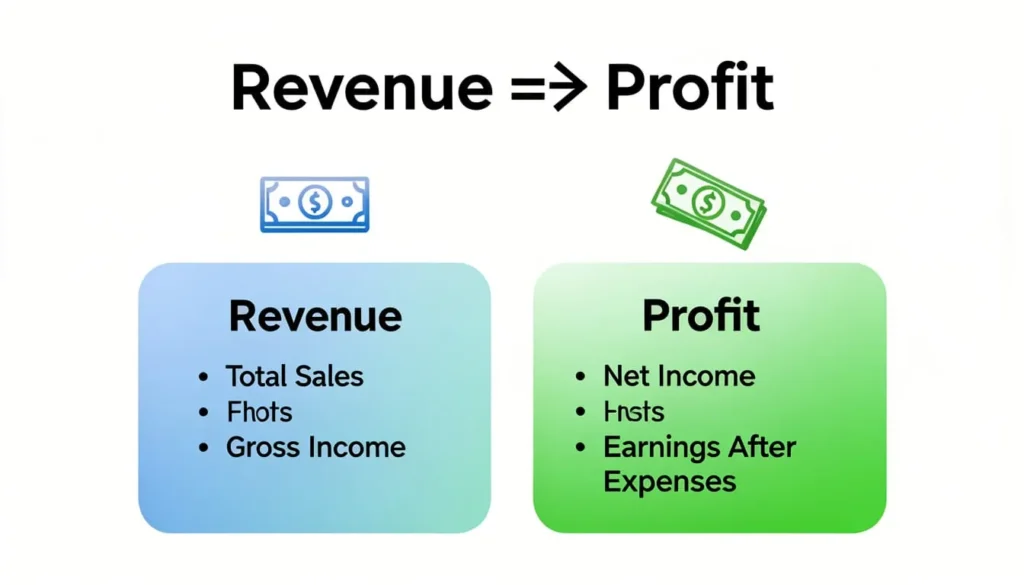
Revenue is the income a business generates from its normal business activities, such as selling products or providing services.
Revenue is often called:
- Sales
- Sales Revenue
- Turnover
- Operating Revenue
- Top Line
For example, suppose a company sells:
- Products: AED 700,000
- Services: AED 200,000
- Other operating sales: AED 100,000
The company’s total revenue is:
AED 1,000,000
This does not mean the company made AED 1,000,000 in profit.
Revenue is generally reported before deducting the costs required to operate the business.
What Is Profit?
Profit is the amount remaining after applicable costs and expenses are deducted from revenue.
A simple version of the formula is:
Revenue − Expenses = Profit
For example:
Revenue: AED 1,000,000
Expenses: AED 800,000
Net Profit: AED 200,000
The business generated AED 1 million in revenue but earned AED 200,000 in net profit.
Revenue vs Profit: The Basic Difference
| Revenue | Profit |
|---|---|
| Total income from business activities | Amount remaining after costs and expenses |
| Also called the Top Line | Often called the Bottom Line |
| Appears near the top of the Income Statement | Appears toward the bottom |
| Does not represent the final earnings | Represents earnings after relevant expenses |
| Can increase while profit decreases | Can decrease even when revenue increases |
Easy way to remember:
Revenue = What the business generates.
Profit = What remains after costs and expenses.
A Simple Real-Life Example
Imagine you operate a café.
During one month, the café generates:
☕ Coffee sales — AED 60,000
🥪 Sandwich sales — AED 25,000
🥤 Cold drink sales — AED 15,000
Total Revenue = AED 100,000
Now consider the costs:
| Expense | Amount |
|---|---|
| Food ingredients | AED 30,000 |
| Staff salaries | AED 25,000 |
| Rent | AED 12,000 |
| Electricity | AED 5,000 |
| Other expenses | AED 8,000 |
| Total Expenses | AED 80,000 |
Therefore:
AED 100,000 Revenue − AED 80,000 Expenses = AED 20,000 Net Profit
The café did AED 100,000 of business, but its profit was AED 20,000.
Revenue Is Not the Same as Cash
This is another important accounting concept.
Revenue does not necessarily mean that the business has already received cash.
Suppose your company sells goods worth AED 100,000 on 30-day credit.
The sale may be recognized as revenue when the applicable revenue-recognition requirements are satisfied, even though the customer will pay later.
You may therefore have:
Revenue: AED 100,000
Cash received: AED 0
The unpaid amount may become Accounts Receivable.
This is why:
Revenue ≠ Cash
And it also means:
Profit ≠ Cash
These distinctions become extremely important when analyzing a company’s financial health.
Revenue, Gross Profit and Net Profit
Profit itself has different levels.
Understanding these levels makes financial statements much easier to read.
1. Revenue
This is the starting point.
Revenue = AED 1,000,000
2. Cost of Goods Sold
If the company sells products, it may incur direct costs associated with those products.
Suppose COGS is:
AED 600,000
Then:
Revenue − COGS = Gross Profit
AED 1,000,000 − AED 600,000 = AED 400,000
Gross Profit = AED 400,000
3. Operating Expenses
Now suppose the company has:
- Salaries
- Rent
- Utilities
- Marketing
- Office expenses
- Insurance
- Professional fees
Total operating expenses:
AED 250,000
Then:
Gross Profit − Operating Expenses = Operating Profit
AED 400,000 − AED 250,000 = AED 150,000
4. Finance Costs, Tax and Other Items
Suppose the company has:
- Finance costs: AED 20,000
- Other applicable expenses: AED 10,000
- Tax expense: AED 30,000
The final result would be:
AED 150,000 − AED 20,000 − AED 10,000 − AED 30,000 = AED 90,000
Net Profit = AED 90,000
The exact presentation varies according to the company’s accounting policies and applicable accounting framework, but the basic concept remains useful.
Why Can Revenue Increase While Profit Falls?
This is one of the most important lessons for business owners.
Imagine:
Year 1
Revenue = AED 1,000,000
Expenses = AED 800,000
Profit = AED 200,000
Year 2
Revenue = AED 1,200,000
Expenses = AED 1,100,000
Profit = AED 100,000
Revenue increased by:
AED 200,000
But profit decreased by:
AED 100,000
Why?
Because expenses increased faster than revenue.
So this statement is not necessarily true:
“Our sales increased, therefore we are more profitable.”
Higher sales are useful—but profitable sales are what ultimately matter.
Revenue vs Gross Profit vs Net Profit
Think of the Income Statement as a journey:
REVENUE
⬇️
Less: Cost of Goods Sold
⬇️
GROSS PROFIT
⬇️
Less: Operating Expenses
⬇️
OPERATING PROFIT
⬇️
Less/Add: Other applicable items
⬇️
PROFIT BEFORE TAX
⬇️
Less: Tax
⬇️
NET PROFIT
This simple structure helps explain why revenue and profit should never be used interchangeably.
What Is the “Top Line”?
Revenue is commonly called the Top Line because it is generally presented near the top of the Income Statement.
When someone says:
“The company grew its top line by 20%.”
They generally mean that revenue increased by approximately 20%.
For example:
Revenue last year = AED 10 million
Revenue this year = AED 12 million
Revenue growth:
20%
But that does not automatically mean profit also increased by 20%.
What Is the “Bottom Line”?
Net profit is commonly referred to as the Bottom Line because it is generally presented toward the bottom of the Income Statement.
For example:
Revenue = AED 10 million
Net Profit = AED 1 million
The company has a 10% net profit margin.
Net Profit Margin
Net Profit ÷ Revenue × 100
In this example:
AED 1,000,000 ÷ AED 10,000,000 × 100 = 10%
The business keeps approximately AED 10 of net profit for every AED 100 of revenue, based on this simplified example.
Revenue and Profit Margin
Revenue alone does not tell you how efficiently a business operates.
Profit margins provide additional information.
Gross Profit Margin
Gross Profit ÷ Revenue × 100
Operating Profit Margin
Operating Profit ÷ Revenue × 100
Net Profit Margin
Net Profit ÷ Revenue × 100
For example:
Revenue = AED 1,000,000
Net Profit = AED 100,000
Net Profit Margin:
10%
This means the business generated AED 10 of net profit for every AED 100 of revenue.
Revenue Can Exist Without Immediate Cash
Consider a company that sells machinery for:
AED 500,000
The customer receives the machinery today and agrees to pay after 60 days, subject to the contractual and accounting requirements for recognizing revenue.
The business may recognize the applicable revenue, while the cash has not yet been collected.
The accounting records may therefore include:
Revenue ↑
and
Accounts Receivable ↑
rather than:
Cash ↑
When the customer eventually pays:
Cash ↑
and
Accounts Receivable ↓
This is why accountants need to understand the difference between accrual accounting and cash movements.
Revenue Does Not Automatically Mean Profit
A company can have:
High Revenue + High Profit
Excellent situation.
High Revenue + Low Profit
The company may have pricing or cost-control problems.
High Revenue + Loss
The business may be generating substantial sales but spending even more to generate them.
Low Revenue + High Margin
A smaller business can sometimes be highly profitable if it has strong pricing and cost control.
Therefore, looking at revenue alone can be misleading.
Revenue vs Profit vs Cash
These three concepts should not be confused.
| Concept | Simple Meaning |
|---|---|
| Revenue | Income generated from business activities |
| Profit | Revenue remaining after applicable costs and expenses |
| Cash | Money currently available in cash/bank accounts |
A business could have:
AED 1 million revenue
AED 200,000 profit
but only:
AED 50,000 cash
The remaining money may be tied up in receivables, inventory, prepaid expenses, or other working-capital items.
Why This Matters to Business Owners
A business owner should not look only at sales.
A better financial review should consider:
1. Revenue
Are sales growing?
2. Gross Profit
Are products/services being sold at a healthy margin?
3. Operating Expenses
Are overheads under control?
4. Net Profit
Is the business actually profitable?
5. Cash Flow
Is there enough cash to meet short-term obligations?
6. Accounts Receivable
Are customers paying on time?
7. Accounts Payable
Are supplier obligations being managed properly?
8. Working Capital
Is too much money tied up in inventory or receivables?
This gives a much more complete picture of business performance.
Common Mistakes About Revenue and Profit
❌ Mistake 1: Revenue = Profit
No.
Revenue is before deducting applicable costs and expenses.
❌ Mistake 2: Profit = Cash
No.
A business can be profitable but have cash-flow problems.
❌ Mistake 3: Higher Revenue Always Means Higher Profit
No.
If expenses increase faster than revenue, profit can fall.
❌ Mistake 4: A Large Bank Balance Means High Profit
Not necessarily.
Cash can come from:
- Loans
- Capital contributions
- Asset sales
- Customer collections
- Other financing activities
Not every cash inflow is revenue.
❌ Mistake 5: Every Cash Inflow Is Revenue
No.
For example, receiving a bank loan increases cash but does not normally create revenue.
A Very Simple Accounting Example
Let’s put everything together.
A company receives AED 1,000,000 in sales.
Its costs are:
COGS: AED 600,000
Operating expenses: AED 250,000
Finance costs: AED 20,000
Other applicable expenses: AED 10,000
Simplified result:
Revenue: AED 1,000,000
Less COGS: AED 600,000
Gross Profit: AED 400,000
Less Operating Expenses: AED 250,000
Operating Profit: AED 150,000
Less Other Applicable Costs: AED 30,000
Profit Before Tax: AED 120,000
If tax expense is AED 20,000:
Net Profit: AED 100,000
So the business generated:
AED 1,000,000 Revenue
but ended with:
AED 100,000 Net Profit
That’s a 10% net profit margin in this simplified example.
The Accounting Equation Behind the Numbers
The basic accounting equation is:
Assets = Liabilities + Equity
Profit ultimately affects equity through retained earnings, subject to distributions and other equity movements.
This is why profit is not simply “money in the bank.”
For example, a profitable business may have its earnings tied up in:
- Accounts Receivable
- Inventory
- Equipment
- Other assets
The accounting records capture these different elements separately.
Revenue Recognition: An Important Basic Concept
Revenue should not simply be recorded whenever cash is received.
Under accrual-based accounting, revenue is generally recognized when the applicable recognition criteria are satisfied—for example, when control of goods or services is transferred to the customer under the relevant accounting requirements.
This is why:
Invoice date, payment date, delivery date and revenue-recognition date can sometimes be different.
For professional accounting work, always apply the relevant accounting framework and the specific terms of the transaction.
How to Analyze Revenue Properly
When reviewing a business, don’t stop at:
“How much did we sell?”
Ask:
- How much revenue did we generate?
- How much did it cost to generate that revenue?
- What is our gross margin?
- What are our operating expenses?
- What is our operating profit?
- What is our net profit?
- How much cash did we generate?
- How much is still outstanding from customers?
- How much do we owe suppliers?
- How much working capital is tied up in the business?
These questions turn accounting numbers into business intelligence.
The Golden Rule
If you remember only one thing from this article, remember this:
Revenue is what your business generates.
Profit is what remains after applicable costs and expenses.
Cash is what is actually available to spend.
They are connected—but they are not the same thing.
Frequently Asked Questions
Is revenue the same as sales?
Often, sales are the primary source of revenue for a business, but revenue can include other operating income depending on the business and accounting presentation.
Is profit the money in the bank?
No. Profit is an accounting result. Cash is the money available in bank and cash accounts.
Can a company have revenue but no profit?
Yes. If total costs and expenses equal or exceed revenue, the company can have zero profit or a loss.
Can a company have profit but little cash?
Yes. Credit sales, inventory investment, debt repayments, capital expenditure and other cash-flow movements can create a significant difference between profit and cash.
Does higher revenue always mean a healthier company?
No. Profit margins, cash flow, debt, working capital, customer concentration and operating efficiency also matter.
What is the difference between gross profit and net profit?
Gross profit generally starts with revenue less cost of goods sold. Net profit is the final profit after the relevant operating, financing, tax and other applicable items.
Final Takeaway
Revenue is important—but revenue alone doesn’t tell the whole story.
A business can look impressive because it generates millions in sales, but the real question is:
How much does the business actually retain after generating those sales, and does it have enough cash to operate?
Understanding the difference between Revenue, Gross Profit, Net Profit and Cash Flow is one of the first steps toward understanding financial statements and making better business decisions.
Remember:
Revenue = Top Line 📈
Profit = Bottom Line 💰
Cash = Money Available 💵
Revenue ≠ Profit ≠ Cash
About the Author
Rohitashva Singhvi
Accountant | Blogger | Digital Marketer
Through Singhvi Online, accounting and finance concepts are explained in simple, practical language for business owners, accounting students, finance professionals and entrepreneurs.
Accounting Simplified. Business Clarified.
Suggested SEO Title
Revenue vs Profit: What Is the Difference? A Complete Accounting Guide
Suggested Meta Description
Understand the difference between revenue, gross profit, net profit and cash flow with simple examples, formulas and practical accounting explanations.
Topic Suggested
- Revenue vs profit (done)
- Difference between revenue and profit
- Revenue and profit explained
- What is revenue in accounting
- What is profit in accounting
- Gross profit vs net profit
- Revenue vs cash
- Profit vs cash
- Accounting basics
- Income statement basics
- Accounting terms
- Financial statements explained
Read below:
https://lnkd.in/p/dG9tGBpU