Tag: tax

  • US Accounting Process

    US Accounting Process

    Accounting is a vital function in every business, serving as the backbone for tracking financial activities and ensuring compliance with financial regulations. For US businesses, understanding the accounting process is essential for maintaining accurate records, evaluating financial health, and making informed decisions. This blog will walk you through the accounting cycle, a systematic method used to record, classify, summarize, and report a company’s financial transactions. Following this guide will help you manage your financial information efficiently and ensure it is consistent, accurate, and ready for decision-making.

    What is the Accounting Cycle?

    The accounting cycle refers to the sequence of steps followed to record, process, and report the financial activities of a business over a specific period. This cycle helps in transforming raw financial data into meaningful information through structured phases. The process typically involves recording each transaction, summarizing account balances, and preparing the financial statements. Understanding each phase ensures a company remains compliant with accounting standards, such as Generally Accepted Accounting Principles (GAAP), and facilitates better financial management.

    US Accounting Process: Step-by-Step for Success

    Let’s explore each step in the US accounting process in detail.

    1. Transaction Analysis: The Starting Point

    The accounting cycle begins with the analysis of business transactions. Identifying and understanding each transaction is crucial because it determines how the event affects the business’s financial standing.

    • Identify Transactions: Every business activity that involves a financial exchange, whether it’s purchasing supplies, selling products, or paying salaries, is considered a transaction. The first step is to pinpoint these economic events.
    • Analyze the Impact: Determine which accounts are affected by each transaction. Accounts may include assets (cash, inventory), liabilities (loans, accounts payable), equity, revenue (sales), and expenses (rent, utilities). Evaluating whether the transaction increases or decreases these accounts helps in maintaining accurate records.

    Understanding these aspects is essential as it lays the groundwork for making accurate journal entries.

    2. Recording Journal Entries: Documenting Transactions

    Once the transactions are identified and analyzed, they are recorded in the journal, commonly known as the “book of original entry.”

    • Record Transactions: Each transaction is recorded in the journal with a date, the accounts involved, and the amounts being debited and credited. This chronological record provides a detailed log of every financial event affecting the business.
    • Debit and Credit System: The accounting process follows a double-entry system, where every transaction is represented with at least one debit and one credit. For example, if a business purchases equipment, the equipment account (an asset) will be debited, while the cash account (another asset) will be credited. This ensures the accounting equation (Assets = Liabilities + Equity) remains balanced.

    3. Posting to the General Ledger: Organizing the Data

    After journalizing, the next step is to post the recorded transactions to the general ledger, which organizes financial data by account. This process allows businesses to review all transactions associated with each account.

    • Transfer Journal Entries to Ledger: Each journal entry is posted to its corresponding ledger account. The general ledger is a collection of all accounts, and it records the cumulative effect of all transactions for each account type.
    • Ensure Organization: By transferring the entries into the general ledger, businesses can easily monitor the performance of specific accounts, such as tracking expenses, cash flow, or liabilities.

    4. Unadjusted Trial Balance: Verifying Initial Accuracy

    The unadjusted trial balance is prepared to ensure that the debits and credits are equal before making any adjustments. It involves listing all the accounts in the general ledger along with their balances.

    • Prepare a Trial Balance: List every account from the general ledger with its balance, categorizing them as debit or credit balances. This serves as a preliminary check to verify that all the recorded transactions were entered correctly.
    • Confirm Debit-Credit Equality: The primary purpose of the trial balance is to ensure that the total debits match the total credits. If they do not, it indicates an error in the recording process that must be corrected before proceeding.

    5. Adjusting Entries: Fine-Tuning the Records

    Adjusting entries are made to update the accounts for revenues and expenses that have not been recorded or for transactions that span multiple accounting periods. This step ensures that the financial statements reflect the true financial position of the business.

    • Accrue or Defer Revenues and Expenses: Adjustments may include accruing revenues earned but not yet received, deferring prepaid expenses, recording depreciation, and adjusting for accrued expenses.
    • Examples of Adjusting Entries:
      • Prepaid Expenses: If a business pays for insurance in advance, an adjusting entry is needed to record the expense as it is incurred over time.
      • Accrued Income: Income that has been earned but not yet received needs to be recorded as a receivable.
      • Depreciation: Adjust for the gradual reduction in value of fixed assets over their useful lives.

    6. Adjusted Trial Balance: Ensuring Updated Accuracy

    After making the necessary adjustments, a new trial balance is prepared. This adjusted trial balance serves as a final check before the preparation of financial statements.

    • Prepare an Adjusted Trial Balance: List all accounts with their updated balances after the adjusting entries. This provides an accurate snapshot of the accounts that will be used to prepare the financial statements.

    7. Preparing Financial Statements: Summarizing the Financial Data

    The primary goal of the accounting cycle is to create financial statements that accurately reflect the company’s financial performance and position. Four key financial statements are prepared:

    • Income Statement: This statement provides a summary of revenues, expenses, and profits or losses over a specific period, revealing how well the business is performing.
    • Balance Sheet: It displays the company’s assets, liabilities, and equity at a specific point in time, offering insights into its financial health.
    • Statement of Cash Flows: This statement tracks the inflow and outflow of cash related to operating, investing, and financing activities, indicating how the company manages its cash.
    • Statement of Retained Earnings: It outlines the changes in retained earnings over the period, including net income and dividends paid.

    8. Closing Entries: Preparing for the New Cycle

    At the end of the accounting period, it is necessary to close temporary accounts, such as revenues, expenses, and dividends, to prepare for the next accounting period.

    • Close Temporary Accounts: Transfer the balances of revenue, expense, and dividend accounts to the retained earnings account to reset their balances to zero for the next period.
    • Prepare a Post-Closing Trial Balance: This trial balance includes only the permanent accounts (assets, liabilities, and equity), confirming that the accounting books are ready for the new cycle.

    Additional Considerations for the US Accounting Process

    While following the steps in the accounting cycle is essential, businesses must also keep a few other considerations in mind to maintain compliance and efficiency.

    • Adherence to Generally Accepted Accounting Principles (GAAP): GAAP provides the framework for consistent and comparable financial reporting across industries. It guides businesses on how to recognize revenues, record expenses, and disclose financial information.
    • Use of Accounting Software: Leveraging accounting software can automate many steps in the accounting cycle, reduce human errors, and improve the efficiency of the entire process. Software solutions can help with transaction recording, adjustments, and financial statement preparation.
    • Implementing Internal Controls: To prevent errors and fraudulent activities, businesses should establish internal controls, such as segregation of duties, regular audits, and reconciliation procedures. These controls help ensure the accuracy and integrity of financial data.

    Benefits of a Well-Executed Accounting Cycle

    Following a structured accounting process provides several advantages for businesses:

    • Accurate Financial Records: Ensures that all financial transactions are accurately recorded and classified, providing a clear picture of the company’s financial position.
    • Informed Decision-Making: Reliable financial data allows business owners and managers to make better decisions regarding investments, budgeting, and strategic planning.
    • Regulatory Compliance: Adhering to accounting standards, such as GAAP, ensures compliance with legal requirements and reduces the risk of penalties or fines.
    • Efficient Financial Reporting: A systematic approach streamlines the preparation of financial statements, allowing businesses to meet deadlines and maintain stakeholder confidence.

    Also Learn: UK Accounting Process – Rohitashva Singhvi

    Conclusion

    The accounting cycle is the cornerstone of financial management for any US business. By understanding and implementing the steps of the accounting process, from transaction analysis to closing entries, companies can ensure their financial records are accurate, complete, and compliant with regulations. This comprehensive guide serves as a roadmap for businesses to navigate the complexities of accounting, enabling them to achieve financial stability and long-term success.

    With the right tools, knowledge, and practices, the accounting process becomes not just a regulatory requirement but a strategic asset that drives business growth and profitability. Make the accounting cycle work for your business and transform your financial data into a powerful decision-making tool.


    Buy US Airways Dividend Miles Today!
  • UK Accounting Process

    UK Accounting Process

    Accounting plays a crucial role in every business, providing a structured way to track financial health and ensure compliance with legal requirements. The UK’s accounting process is no different, governed by distinct regulations and standards. In this comprehensive guide, we’ll walk you through each step of the UK accounting process, from understanding the relevant standards to preparing financial statements. Whether you’re a small business owner, a finance professional, or just someone looking to understand the basics, this guide will provide you with a thorough understanding of the UK’s accounting process.

    UK Accounting Process: A Step-by-Step Approach

    Understanding UK Accounting Standards

    Before diving into the steps involved in the UK accounting process, it is essential to grasp the foundational standards that govern accounting practices. In the UK, accounting is regulated by the Companies Act 2006, which outlines the legal requirements for financial reporting. Additionally, the Financial Reporting Council (FRC) sets the guidelines for accounting practices by issuing Financial Reporting Standards (FRS), which are the UK equivalent of the International Financial Reporting Standards (IFRS).

    Key UK Accounting Standards to Know:

    • Companies Act 2006: Governs the legal framework for company accounts, including requirements for bookkeeping, auditing, and financial reporting.
    • Financial Reporting Standards (FRS): Published by the FRC, these standards ensure consistency and transparency in financial reporting. They include standards like FRS 102 (The Financial Reporting Standard applicable in the UK and Republic of Ireland) and FRS 105 (The Financial Reporting Standard applicable to micro-entities).

    Understanding these standards will help ensure that your accounting practices align with legal requirements and best practices.

    Key Steps in the UK Accounting Process

    The UK accounting process follows a systematic approach that ensures accuracy and completeness. Below is a detailed guide to each step.

    1. Transaction Recording: The Foundation of Accounting

    The first step in the accounting process is to record all financial transactions. This step ensures that every monetary movement within the business is documented.

    Steps Involved:

    • Source Documents: Begin by collecting all source documents such as invoices, receipts, bank statements, and purchase orders. These documents serve as the evidence for each financial transaction and are crucial for maintaining an audit trail.
    • Journal Entries: Transactions are then recorded in a journal. This involves identifying the accounts affected by each transaction and determining whether they should be debited or credited.
    • Double-Entry System: The double-entry bookkeeping method is employed to ensure accuracy, meaning every transaction is recorded twice: once as a debit and once as a credit. This system ensures that the accounting equation (Assets = Liabilities + Equity) remains balanced.

    2. Posting to the General Ledger: Organizing the Accounts

    Once transactions are recorded in the journal, the next step is to post these entries to the general ledger.

    Key Aspects:

    • General Ledger (GL): The general ledger is a comprehensive collection of all the accounts used in the company’s accounting system, including assets, liabilities, income, and expenses.
    • Account Balancing: Each account in the GL must be balanced to ensure that the total debits equal the total credits. This step is crucial for maintaining accurate financial records.

    3. Sub-Ledger Maintenance: Diving Deeper into Specific Accounts

    Sub-ledgers offer more detailed insights into specific types of transactions, providing a more granular view of the company’s financial activities.

    Common Sub-Ledgers Include:

    • Customer Ledger: Tracks all transactions related to individual customers, including sales, payments, and outstanding balances.
    • Supplier Ledger: Monitors transactions with suppliers, such as purchases and payments.
    • Bank and Cash Ledger: Documents all bank-related transactions, including deposits, withdrawals, and bank charges.

    Maintaining accurate sub-ledgers helps in managing accounts receivable, accounts payable, and cash flow effectively.

    4. Trial Balance Preparation: Checking for Accuracy

    After posting transactions to the general and sub-ledgers, a trial balance is prepared to check for any discrepancies in the accounting records.

    Steps to Prepare a Trial Balance:

    • List All General Ledger Accounts: Prepare a list of all the accounts along with their balances.
    • Calculate Total Debits and Credits: The trial balance ensures that total debits equal total credits. If they do not match, it indicates an error in the previous steps.

    This step serves as an internal check to identify mistakes before proceeding to the preparation of financial statements.

    5. Adjusting Entries: Making Corrections for Accurate Reporting

    Adjusting entries are made at the end of an accounting period to account for revenues and expenses that have not yet been recorded.

    Common Types of Adjusting Entries:

    • Accruals: Recognize revenues that have been earned but not yet received, and expenses that have been incurred but not yet paid.
    • Deferrals: Account for payments that have been made in advance for future expenses (prepaid expenses) or revenues received in advance for future services (unearned revenue).

    Making these adjustments ensures that the financial statements accurately reflect the company’s financial position.

    6. Preparing the Adjusted Trial Balance: A Second Check

    Once the adjusting entries are made, a new trial balance, known as the adjusted trial balance, is prepared. This step serves as a final check to ensure that all the adjustments have been properly recorded.

    7. Financial Statements Preparation: Presenting the Company’s Financial Health

    With the adjusted trial balance ready, the next step is to prepare the financial statements. These reports provide a snapshot of the company’s financial health and are used by stakeholders to make informed decisions.

    Key Financial Statements Include:

    • Income Statement: Also known as the profit and loss statement, it shows the company’s revenues, expenses, and net profit or loss over a specific period.
    • Balance Sheet: Presents the company’s assets, liabilities, and equity as of a specific date, providing insights into its financial stability.
    • Cash Flow Statement: Highlights the cash inflows and outflows from operating, investing, and financing activities, offering a clear view of the company’s liquidity.

    8. Note Disclosure: Providing Additional Insights

    Financial statements are often accompanied by notes that provide additional details and context to help stakeholders better understand the company’s financial situation.

    Common Disclosures Include:

    • Accounting Policies: Information about the accounting methods and assumptions used in preparing the financial statements.
    • Contingent Liabilities: Potential obligations that may arise depending on the outcome of future events.
    • Significant Transactions: Details about major transactions or changes in the company’s financial position during the reporting period.

    Additional Considerations for UK Accounting

    While following the steps outlined above will help you establish a strong accounting foundation, there are additional factors to consider when managing your financial records in the UK.

    Tax Compliance: Navigating UK Tax Laws

    Businesses in the UK must comply with various tax regulations, including Corporation Tax, Value Added Tax (VAT), and Pay As You Earn (PAYE) for employee income taxes. Staying updated on tax deadlines, filing requirements, and applicable rates is essential to avoid penalties.

    Choosing Bookkeeping Software: Automate and Simplify

    Using accounting software can significantly streamline the process by automating tasks such as transaction recording, bank reconciliation, and financial reporting. Popular options include Sage, QuickBooks, and Xero, which offer features tailored to different business needs.

    Consulting a Professional Accountant: Expert Guidance

    For complex accounting issues or business-specific requirements, seeking advice from a qualified accountant or tax advisor can help ensure compliance with UK standards and optimize your financial strategy.

    Specific Requirements for Different Business Structures

    The UK accounting process may vary depending on the type of business. Here’s a brief overview of what different structures should consider:

    Sole Traders

    • Simple Record-Keeping: Sole traders have fewer regulatory requirements and can use simpler bookkeeping methods.
    • Personal and Business Finances: These businesses must still separate personal finances from business accounts for tax purposes.

    Partnerships

    • Partnership Agreement: Establish clear accounting practices in the partnership agreement to avoid disputes.
    • Separate Accounts for Partners: Keep detailed records of each partner’s capital contributions, profit share, and withdrawals.

    Limited Companies

    • Statutory Accounts: Limited companies are required to file statutory accounts with Companies House and comply with stricter reporting standards.
    • Annual Returns: Submit annual financial statements and a confirmation statement to maintain compliance.

    Must Read: International Accounting: US vs. UK – Rohitashva Singhvi

    Conclusion

    The UK accounting process is a structured and essential part of running a business, ensuring financial accuracy and regulatory compliance. By following this step-by-step guide, understanding the relevant accounting standards, and utilizing the right tools, you can maintain reliable financial records that support informed decision-making.

    Whether you’re a sole trader, a partnership, or a limited company, each step—from transaction recording to financial statement preparation—plays a vital role in the overall accounting process. Embrace these practices to stay on top of your business’s finances and ensure long-term success.


    Stay Inside
  • International Accounting: US vs. UK

    International Accounting: US vs. UK

    Understanding the intricacies of international accounting is crucial for businesses operating across borders, especially when dealing with the unique accounting standards of different countries. The United States and the United Kingdom, while sharing some accounting principles, follow different sets of rules that can significantly impact financial reporting and business operations. Here, we dive into the primary differences between US and UK accounting practices and offer valuable insights for businesses working in international markets.

    International Accounting: Navigating the Key Differences Between the US and UK

    Bridging the Gap: US GAAP vs. UK IFRS

    The United States follows the Generally Accepted Accounting Principles (GAAP), which are established by the Financial Accounting Standards Board (FASB). The UK, on the other hand, generally adheres to International Financial Reporting Standards (IFRS), issued by the International Accounting Standards Board (IASB). While efforts towards convergence between GAAP and IFRS are ongoing, some significant differences remain. Here’s what you need to know.

    Key Differences in US and UK Accounting Practices

    1. Inventory Valuation Methods

    • US (GAAP): Companies can use the Last In, First Out (LIFO) method for inventory valuation, where the most recently acquired inventory is the first to be used or sold. This can be beneficial during times of inflation as it results in higher cost of goods sold and lower taxable income.
    • UK (IFRS): The LIFO method is prohibited. Instead, companies typically use First In, First Out (FIFO) or a weighted average method, which may result in higher inventory valuations during inflationary periods compared to LIFO.

    2. Revenue Recognition Principles

    • US (GAAP): The criteria for recognizing revenue are specific and often more detailed, requiring entities to adhere to strict guidelines. Revenue is recognized when it is earned and realizable, often involving complex criteria for contract-based businesses.
    • UK (IFRS): Revenue recognition under IFRS focuses more on the transfer of control rather than the earning process. While similar to GAAP in many respects, the principles can vary, especially in cases of long-term contracts or service-based revenues.

    3. Asset Impairment Testing

    • US (GAAP): A two-step impairment process is used. First, a recoverability test is conducted to determine if the asset’s carrying value exceeds its expected future cash flows. If so, a fair value test follows to measure the impairment loss.
    • UK (IFRS): A single-step impairment test is applied, comparing the asset’s carrying value directly with its recoverable amount (higher of fair value less costs to sell or value in use). This approach simplifies the impairment testing process but may lead to earlier recognition of losses.

    4. Financial Statement Presentation

    • US (GAAP): Financial statements, particularly the balance sheet, are often presented in a classified format, distinguishing current from non-current assets and liabilities for better clarity.
    • UK (IFRS): While UK financial statements can be classified, there is more flexibility in presentation. The format may vary, with some companies opting for less classified formats or different presentation styles, depending on the nature of the business.

    5. Disclosure Requirements

    • US (GAAP): Disclosure requirements tend to be more extensive and detailed, aiming to provide comprehensive information to investors and regulators. This level of detail is crucial for compliance with the SEC and other regulatory bodies.
    • UK (IFRS): Although disclosure requirements are also rigorous, they may be slightly less detailed compared to US standards. However, there is a continuous push towards greater transparency in financial reporting.

    International Accounting Considerations: Best Practices for Global Businesses

    Navigating international accounting differences can be challenging, especially for businesses that operate in both the US and UK. Here are some critical considerations to ensure compliance and accuracy in financial reporting:

    1. Compliance with Local Standards

    Ensure that financial statements comply with the specific accounting standards of each country. This may require preparing separate sets of financial statements or making adjustments to align with local GAAP or IFRS requirements. Understanding the nuances of each system can help avoid costly errors.

    2. Currency Translation Challenges

    Currency fluctuations can significantly impact financial reporting, especially when converting foreign revenues, expenses, and asset values. Businesses should employ appropriate currency translation methods, such as the current rate method or temporal method, and consider the effects of exchange rate changes on consolidated financial statements.

    3. Tax Implications of Different Accounting Methods

    Different accounting standards can lead to variations in taxable income, which affects tax liabilities. For instance, using LIFO in the US can result in lower taxable income during inflation, whereas the UK’s prohibition of LIFO could lead to higher tax obligations. Understanding these implications is essential for effective tax planning.

    4. Seek Professional Guidance

    Given the complexities involved in international accounting, it is wise to seek advice from experienced accountants or tax professionals who specialize in cross-border financial reporting. Their expertise can help ensure that financial statements are accurate, compliant, and aligned with global best practices.

    Why International Accounting Standards Matter for Your Business?

    Whether you are expanding your business to new markets or working with international partners, understanding the differences between US and UK accounting standards can offer a competitive advantage. Properly navigating these distinctions not only ensures compliance but also enhances financial transparency and credibility in the eyes of investors, regulators, and other stakeholders.

    By being aware of the key differences in inventory valuation, revenue recognition, asset impairment, financial statement presentation, and disclosure requirements, businesses can better manage their financial reporting processes and avoid potential pitfalls.

    Conclusion

    As globalization continues to blur the lines between national economies, the importance of understanding international accounting standards cannot be overstated. The US and UK may share similar goals in financial reporting, but their accounting practices still exhibit notable differences. For businesses operating internationally, staying informed about these differences—and seeking professional guidance when needed—can make all the difference in achieving financial accuracy, compliance, and success.


    An All-in-One Business Solution, QuickBooks Helps You Organize Your Finances And Be Ready For Tax Time.
    An All-in-One Business Solution, QuickBooks Helps You Organize Your Finances And Be Ready For Tax Time. Click now for more info.

  • Essential Guide to Corporate Tax Documentation in the UAE for 2024

    Essential Guide to Corporate Tax Documentation in the UAE for 2024

    As corporate tax regulations evolve, businesses in the UAE must adapt to stay compliant and efficient in their financial management. One of the most critical aspects of corporate tax management is ensuring that your documentation is accurate and well-organized. This blog will explore why proper documentation is crucial for corporate tax in the UAE, particularly in 2024, with evolving tax laws and greater scrutiny from authorities. Let’s understand why documentation is important for corporate tax in UAE:

    Must Read: Calculating Corporate Tax for a Free Zone Person – Rohitashva Singhvi

    Why Proper Documentation is Crucial for Corporate Tax in the UAE – 2024 Guide

    The Importance of Proper Corporate Tax Documentation

    When dealing with corporate tax in the UAE, having a robust system for maintaining and managing your documentation can offer multiple advantages. Let’s explore the main reasons why proper documentation is essential for your business:

    1. Compliance with Tax Laws

    Staying compliant with UAE’s corporate tax laws is not optional—it’s a necessity. As businesses navigate the regulations, the importance of thorough documentation becomes even more apparent.

    Avoiding Penalties: In 2024, the UAE’s corporate tax regime has grown stricter in enforcing regulations. One of the primary reasons for maintaining accurate documentation is to avoid penalties and fines. Incomplete or erroneous documentation can lead to tax miscalculations, ultimately resulting in heavy penalties. By ensuring that your business’s financial records are detailed and precise, you are protecting it from potential legal action or financial losses.

    Supporting Claims: Accurate documentation also supports any tax deductions, credits, or exemptions you may claim. For instance, if your business claims tax deductions on expenses, proper receipts and invoices can serve as evidence to back up those claims. This level of thoroughness ensures that you comply with local tax regulations and that you maximize the financial benefits available under the UAE’s tax regime.

    2. Accurate Tax Calculations

    Another vital role of proper documentation is to facilitate accurate tax calculations. With precise record-keeping, businesses can prevent tax errors, which can have costly consequences.

    Preventing Errors: Errors in tax calculations can either lead to overpayment or underpayment, both of which are undesirable outcomes. Overpayment may negatively affect your cash flow, while underpayment can trigger penalties. By maintaining comprehensive documentation, such as invoices, payroll records, and bank statements, you can avoid these pitfalls and ensure accurate tax filings in the UAE.

    Supporting Audits: Tax audits are an inevitable reality for many businesses, especially with the UAE’s increasing focus on corporate tax compliance in 2024. If your business is selected for an audit, having accurate and well-organized documentation can save you from unnecessary stress. It enables you to provide clear evidence and explanations to support your tax filings, reducing the risk of penalties or further investigations.

    3. Financial Transparency

    In addition to ensuring compliance and accuracy, proper documentation also plays a significant role in maintaining financial transparency—a crucial factor for building trust with stakeholders.

    Stakeholder Confidence: Investors, lenders, and other stakeholders in your business rely on transparent financial records to gauge your company’s financial health. If your documentation is incomplete or disorganized, it can erode their confidence. On the other hand, well-maintained financial records demonstrate that your business is transparent, organized, and well-managed. This trust is particularly important if you are seeking external financing or looking to attract new investors in 2024.

    Decision-Making: Accurate financial records provide invaluable insights into your business’s financial position. These records are essential for making informed decisions on budgeting, cost-cutting, and investments. With the UAE’s corporate tax laws potentially impacting cash flow, having a clear understanding of your company’s finances can help you make strategic decisions that optimize your tax liabilities and enhance profitability.

    4. Maintaining Historical Records

    Having proper historical records is crucial for both ongoing financial analysis and in the event of legal disputes.

    Business Analysis: Analyzing your company’s historical financial performance is key to identifying trends, making forecasts, and planning for future growth. With proper documentation in place, you can easily access past records to perform financial analyses that will help in decision-making. For instance, reviewing historical tax filings and financial statements can highlight areas where your business may be able to improve its efficiency or reduce tax liabilities.

    Legal Disputes: In the unfortunate event of a legal dispute, your documentation can serve as a powerful form of evidence. Whether it involves disputes with clients, employees, or tax authorities, accurate and organized records can strengthen your position. It ensures you can back up your claims with facts and figures, reducing the likelihood of unfavorable legal outcomes.

    Key Documents to Maintain for Corporate Tax Compliance in the UAE

    Now that we’ve explored the importance of proper documentation, it’s essential to know which documents you should prioritize. Here’s a breakdown of key documents that UAE businesses should maintain for corporate tax purposes in 2024:

    1. Financial Statements

    Financial statements such as income statements, balance sheets, and cash flow statements are the backbone of your corporate tax filings. These documents provide a clear snapshot of your business’s financial health, making them essential for accurate tax calculations and supporting claims.

    2. Invoices and Receipts

    Keeping all invoices and receipts related to sales, purchases, and business expenses is critical. These documents substantiate any deductions or credits claimed and serve as a reference in case of discrepancies.

    3. Payroll Records

    Payroll records are essential for tracking employee wages, deductions, and tax withholdings. These records not only help in complying with tax regulations but also ensure that employee compensation is accurately reflected in your tax filings.

    4. Bank Statements

    Bank statements provide an additional layer of financial transparency, ensuring that all business transactions are accurately reflected in your tax documentation. Keeping detailed bank records will help reconcile discrepancies between your financial statements and actual cash flow.

    5. Contracts and Agreements

    Maintaining contracts and agreements with suppliers, customers, and employees is essential for documenting the nature of business transactions. These records can be useful for verifying the legitimacy of certain expenses or deductions, especially during audits.

    6. Expense Reports

    Employee-incurred expenses can add up, and proper documentation is necessary to claim these expenses as tax deductions. Ensure that detailed expense reports are maintained, along with supporting documentation such as receipts and invoices.

    7. Tax Returns

    Finally, it’s essential to keep a record of all past tax returns and their supporting documentation. This can serve as a point of reference when preparing future tax filings and can be crucial in the event of an audit or tax dispute.

    How Proper Documentation Minimizes Tax Risks

    Maintaining proper documentation is one of the best ways to minimize tax-related risks. Here are some ways how good documentation can protect your business:

    • Reduced Risk of Penalties: Ensuring that all records are accurate and up-to-date means fewer chances of discrepancies or miscalculations in your tax filings, reducing the likelihood of penalties.
    • Improved Audit Preparedness: In the event of a tax audit, proper documentation allows you to respond quickly and effectively, providing clear evidence to support your claims.
    • Increased Financial Control: Comprehensive documentation gives you more control over your finances, allowing you to identify areas where you can cut costs, optimize deductions, and better manage your tax liabilities.
    • Legal Protection: In the case of legal disputes, proper documentation serves as evidence, helping you resolve disputes in your favor and protecting your business from financial liabilities.

    The Role of Digital Solutions in Documentation

    As the UAE’s corporate tax landscape evolves in 2024, many businesses are turning to digital solutions to streamline their documentation processes. Cloud-based accounting software and tax management platforms allow businesses to maintain accurate and organized records while reducing the administrative burden.

    These digital tools can automatically generate financial statements, track expenses, and store important documents in one place, making it easier to access and manage your records. With real-time reporting and audit trails, these tools also enhance transparency and compliance.

    Conclusion: The Future of Corporate Tax Documentation in the UAE

    As the UAE’s corporate tax laws continue to evolve, maintaining proper documentation is more important than ever. Businesses that prioritize accuracy, organization, and transparency in their financial records will not only ensure compliance with tax laws but also gain valuable insights into their financial health, improve decision-making, and build trust with stakeholders.

    By focusing on comprehensive documentation, UAE businesses can mitigate the risk of penalties, avoid costly errors, and make strategic decisions that foster long-term growth. Whether you’re a small business or a large corporation, the importance of proper documentation cannot be overstated. As we move forward in 2024, investing in a robust documentation system is key to thriving in the UAE’s increasingly regulated corporate tax environment.

    Must Read: Top 50 Financial Accounting Terms – Rohitashva Singhvi

    QuickBooks Online CA Home Page Save 50% off QuickBooks for 1st 6 months at QuickBooks Online CA! Buy Now!
  • Calculating Corporate Tax for a Free Zone Person

    Calculating Corporate Tax for a Free Zone Person

    Corporate Tax Rate for a QFZP

    If a Free Zone Person (FZP) meets all the conditions, including the de minimis requirements, to be a Qualifying Free Zone Person (QFZP), the applicable Corporate Tax rates are:

    • 0% Corporate Tax rate on Qualifying Income
    • 9% Corporate Tax rate on Taxable Income that is not Qualifying Income

    Note: A QFZP is not entitled to a 0% Corporate Tax rate on its first AED 375,000 of Taxable Income.

    Qualifying Income

    Qualifying Income is defined based on the following categories:

    • Transactions with a Free Zone Person who is the Beneficial Recipient of the transaction (excluding Revenue from Excluded Activities)
    • Transactions related to Qualifying Activities (excluding Revenue from Excluded Activities)
    • Qualifying Income from Qualifying Intellectual Property
    • Other sources (including Revenue from Excluded Activities) if the QFZP meets the de minimis requirements

    Revenue from the following sources does not qualify as Qualifying Income, even if it falls within the categories listed above:

    • Revenue attributable to a Foreign Permanent Establishment
    • Revenue attributable to a Domestic Permanent Establishment
    • Revenue from Immovable Property (other than Commercial Property located in a Free Zone when the income arises from a transaction with a Free Zone Person)
    • Revenue from the ownership or exploitation of intellectual property (other than Qualifying Income from Qualifying Intellectual Property)

    Taxable Income That Is Not Qualifying Income

    To determine the Taxable Income that is not Qualifying Income, which will be subject to the 9% Corporate Tax rate, a QFZP must:

    • Separate the Revenue in its Financial Statements into Revenue pertaining to the Qualifying Income component and the Taxable Income component.
    • Allocate the expenses in its Financial Statements against these components in a reasonable manner, consistent with the arm’s length principle.
    • Apply Article 20 of the Corporate Tax Law (general rules for determining Taxable Income) to determine the Taxable Income that is not Qualifying Income.

    Corporate Tax on QFZP with a Domestic Permanent Establishment

    Example: Company J

    Revenue for the Tax Period Ending 31 December 2024:

    • AED 1,000,000 attributable to Qualifying Activities that are not Excluded Activities performed in a Free Zone.
    • AED 2,000,000 attributable to activities conducted through a Domestic Permanent Establishment.

    Operating Expenses for the Tax Period:

    • AED 600,000 incurred by the Free Zone parent.
    • AED 1,400,000 incurred by its Domestic Permanent Establishment.
    • AED 300,000 incurred in the Domestic Permanent Establishment for HR administrative activities that support both the Free Zone parent and Domestic Permanent Establishment. Applying an appropriate allocation key (e.g., relative headcount), Company J determines that 50% of these expenses should be attributed to its Free Zone parent.

    Allocation of Revenue and Expenses: Based on the arm’s length principle, Company J determines that the Revenue and expenses in its Financial Statements for the Tax Period ending 31 December 2024 can be allocated between Qualifying Income and Taxable Income as follows (amounts in AED):

    ItemsTotalDomestic Permanent Establishment (Taxable Income)Free Zone Parent (Qualifying Income)
    Revenue3,000,0002,000,0001,000,000
    Less: Direct expenses2,000,0001,400,000600,000
    Less: Allocated expenses300,000150,000150,000
    Profit700,000450,000250,000
    Calculation Table

    Corporate Tax Calculation:

    • Company J will be subject to a 0% Corporate Tax rate on its Qualifying Income of AED 250,000.
    • Company J will be subject to a 9% Corporate Tax rate on the AED 450,000 profit attributable to its Domestic Permanent Establishment, resulting in a Corporate Tax of AED 40,500.

    This calculation assumes there are no further adjustments as per Article 20 of the Corporate Tax Law.

    References:

    • Article 3(2) of the Corporate Tax Law
    • Article 3(1) of Cabinet Decision No. 100 of 2023
    • Corporate Tax Guide | Free Zone Persons | CTGFZP1
  • Top 50 Financial Accounting Terms

    Top 50 Financial Accounting Terms

    Explore this helpful glossary of 50 important accounting terms that are essential for financial accounting. This list covers everything from basic accounting software to advanced financial analysis tools, providing easy-to-understand definitions. Whether you’re an accountant, business owner, or student, knowing these terms will help you manage finances more effectively.

    1. Financial Accounting Software:Software applications designed to record, store, and process financial transactions for businesses and organizations.
    2. Accounting ERP Systems:Enterprise Resource Planning (ERP) systems that integrate accounting functions with other core business processes like inventory management, human resources, and customer relationship management.
    3. Cloud Accounting Software:Accounting software hosted on remote servers, accessed through the internet, and offered on a subscription basis.
    4. Financial Statement Preparation:The process of compiling and presenting a company’s financial performance and position through balance sheets, income statements, and cash flow statements.
    5. Tax Preparation Software:Software that assists individuals and businesses in preparing and filing their tax returns.
    6. Payroll Software:Software used to automate the calculation, management, and distribution of employee wages and salaries.
    7. Financial Reporting Tools:Software applications designed to facilitate the creation, analysis, and distribution of financial reports.
    8. Financial Analysis Software:Tools used to evaluate financial data and assess the performance, profitability, and stability of a business.
    9. CPA Exam Review:Courses and materials designed to prepare candidates for the Certified Public Accountant (CPA) exam.
    10. Financial Advisor:A professional who provides financial advice and guidance to individuals and businesses.
    11. CFO Services:Outsourced Chief Financial Officer (CFO) services providing financial expertise and strategic planning for businesses.
    12. Financial Audit:An independent examination of a company’s financial records and statements to ensure accuracy and compliance with accounting standards.
    13. Internal Audit:An independent appraisal function within an organization to examine and evaluate its activities as a service to the organization.
    14. Forensic Accounting:The application of accounting principles and investigative techniques to gather evidence for legal proceedings.
    15. Financial Planning:The process of setting financial goals, developing strategies, and managing resources to achieve those goals.
    16. Investment Banking:A financial services sector that deals with the creation of capital for other companies, governments, and other entities.
    17. Asset Management: The professional management of various securities (shares, bonds, etc.) and other assets (e.g., real estate), to meet specified investment goals for the benefit of the investors.
    18. Corporate Finance: The area of finance dealing with the sources of funding and the capital structure of corporations, the actions that managers take to increase the value of the firm to the shareholders, and the tools and analysis used to allocate financial resources.
    19. Tax Accounting:The accounting for tax purposes, following the rules laid down by the tax authorities.
    20. Management Accounting: Also known as managerial accounting or cost accounting, it is the process of identifying, measuring, analyzing, interpreting, and communicating information for the pursuit of an organization’s goals.
    21. Government Accounting: The process of recording, analyzing, classifying, summarizing, communicating, and interpreting financial information about the government in aggregate and in detail reflecting transactions and other economic events involving the receipt, spending, transfer, usability, and disposition of assets and liabilities.
    22. Financial Modeling:The task of building an abstract representation (a model) of a real-world financial situation.
    23. Financial Forecasting:The process of estimating future financial outcomes for a company or country.
    24. Budgeting and Planning:The process of creating a plan to spend your money. This spending plan is called a budget.
    25. Variance Analysis:The quantitative investigation of the difference between actual and planned behavior.
    26. Financial Risk Management: The practice of identifying potential risks in advance, analyzing them and taking precautionary steps to reduce/curb the risk.
    27. Financial Compliance:The process of ensuring that companies are aware of and take steps to comply with relevant laws, policies, and regulations.
    28. Financial Fraud Investigation:The process of determining whether a fraud has occurred and if so, the perpetrator of the fraud.
    29. Accounting Standards (IFRS, GAAP): A common set of principles, standards, and procedures that define the basis of financial accounting policies and practices.
    30. Financial Statements (Balance Sheet, Income Statement, Cash Flow):A collection of summary-level reports about an organization’s financial results, financial position, and cash flows.
    31. Accounts Receivable Management:The process of managing money owed to a company by its debtors.
    32. Accounts Payable Management:The process of managing money owed by a company to its creditors.
    33. Inventory Management:The process of ordering, storing and using a company’s inventory: raw materials, components, and finished products.
    34. Fixed Asset Management:The process of managing a company’s physical assets, such as property, plant, and equipment.
    35. Financial Ratios:A relative magnitude of two selected numerical values taken from a company’s financial statements.
    36. Financial KPIs:A measurable value that demonstrates how effectively a company is achieving key business objectives.
    37. Bookkeeping Services: The recording of financial transactions, and is part of the process of accounting in business.
    38. Accounting Certifications (CPA, CMA, etc.):A professional certification of competency in the field of accounting.
    39. Financial Advisor Salary: The average salary for a financial advisor.
    40. Accounting Job Description: A formal account of an employee’s responsibilities.
    41. Accounting Career Path: The series of jobs that someone can have during their working life in the field of accounting.
    42. Accounting Education Requirements: The minimum level of education required for an accounting role.
    43. Accounting News: Information about recent events or happenings, especially as reported by newspapers, periodicals, radio, or television, related to the field of accounting.
    44. Accounting Blog: A discussion or informational website published on the World Wide Web consisting of discrete, often informal diary-style text entries (posts) related to the field of accounting.
    45. Accounting Podcast: A digital audio file made available on the Internet for downloading to a computer or mobile device, typically available as a series, new installments of which can be received by subscribers automatically, related to the field of accounting.
    46. Accounting Forum: An online message board where users can have conversations in the form of posted messages related to the field of accounting.
    47. Accounting Conferences:A meeting at which a specific topic is discussed, in this case accounting.
    48. Financial Statement Analysis: A method of reviewing and analyzing a company’s accounting reports (financial statements) in order to gauge its past, present or projected future performance.
    49. Depreciation:An accounting method of allocating the costof a tangible or physical asset over its useful life or life expectancy.
    50. Amortization: The paying off of debt with a fixed repayment schedule in regular installments over a period of time.

    Learning these 50 accounting terms is crucial for anyone in the financial field. From basic bookkeeping to advanced financial forecasting, this glossary gives you the knowledge you need to succeed in financial accounting. Use this list to make better business decisions, stay compliant with industry standards, and grow in your career. Save this glossary and refer to it whenever you need to refresh your understanding of important accounting concepts.

  • A Deep Dive into the UAE Corporate Tax & Currency Conversion Guidelines

    A Deep Dive into the UAE Corporate Tax & Currency Conversion Guidelines

    In June 2023, the United Arab Emirates (UAE) witnessed a significant shift in its economic landscape with the introduction of the Corporate Tax. For businesses operating in the region, understanding and adhering to the associated guidelines became paramount. In this blog post, we’ll unravel the intricacies of these guidelines, providing businesses with a comprehensive roadmap to navigate the UAE’s tax framework.

    1. Calculate Taxable Income:

    The journey begins with calculating your company’s taxable income—a fundamental step in the tax process. Businesses must meticulously determine their profits after factoring in allowable deductions and expenses. The guidelines offer clarity on which expenses are deductible and provide insights into handling unique situations, such as foreign income and free zone operations.

    1. Apply the Tax Rate:

    Once your taxable income is established, the next step is applying the tax rate. The standard corporate tax rate in the UAE stands at 9%. However, exemptions and reduced rates are applicable to certain entities. Understanding this is crucial, as it determines the percentage of your taxable income that will be allocated to tax obligations.

    1. Convert Foreign Currency Transactions:

    Operating in a global economy often involves dealing with multiple currencies. For tax purposes, the UAE dirham (AED) is the official currency, necessitating the conversion of foreign transactions into AED. This involves utilizing exchange rates set by the authorities to translate the value of income earned in other currencies into AED for accurate tax calculations.

    1. Comply with Reporting and Payment Requirements:

    Fulfilling reporting and payment obligations marks the final leg of this journey. The guidelines meticulously outline deadlines and procedures for electronically filing tax returns and making timely tax payments. Compliance at this stage ensures businesses meet their tax obligations accurately and within the stipulated time frames.

    Additional Considerations:

    Given the novelty of these guidelines, businesses should remain vigilant for any further clarifications or updates from the authorities. Staying informed is key, and consulting with qualified tax professionals is strongly advised to ensure continued compliance with the evolving tax landscape.

    Remember:

    It’s important to note that this information serves as a general guide and does not constitute financial or tax advice. Businesses are encouraged to seek professional guidance to address their specific circumstances and ensure compliance with the UAE Corporate Tax & Currency Conversion Guidelines.

    Conclusion:

    In conclusion, these guidelines serve as a compass for businesses navigating the complex terrain of the UAE Corporate Tax. By understanding and implementing these steps, companies can not only meet their tax obligations but also contribute to the economic stability and growth of the UAE. Stay informed, seek professional advice, and embark on this journey with confidence and compliance.

  • UAE Corporate Tax – All in one basic info

    UAE Corporate Tax – All in one basic info

    What is Corporate Tax?

    Corporate Tax is a form of direct tax levied on the net income of corporations and other businesses.

    Corporate Tax is sometimes also referred to as “Corporate Income Tax” or “Business Profits Tax” in other jurisdictions.

    Who is subject to Corporate Tax?

    Broadly, Corporate Tax applies to the following “Taxable Persons”:

    • UAE companies and other juridical persons that are incorporated or effectively managed and controlled in the UAE;
    • Natural persons (individuals) who conduct a Business or Business Activity in the UAE as specified in a Cabinet Decision to be issued in due course; and
    • Non-resident juridical persons (foreign legal entities) that have a Permanent Establishment in the UAE (which is explained under [Section 8]).

    Juridical persons established in a UAE Free Zone are also within the scope of Corporate Tax as “Taxable Persons” and will need to comply with the requirements set out in the Corporate Tax Law. However, a Free Zone Person that meets the conditions to be considered a Qualifying Free Zone Person can benefit from a Corporate Tax rate of 0% on their Qualifying Income (the conditions are included in [Section 14]).

    Non-resident persons that do not have a Permanent Establishment in the UAE or that earn UAE sourced income that is not related to their Permanent Establishment may be subject to Withholding Tax (at the rate of 0%). Withholding tax is a form of Corporate Tax collected at source by the payer on behalf of the recipient of the income. Withholding taxes exist in many tax systems and typically apply to the cross-border payment of dividends, interest, royalties and other types of income.

    Who is exempt from Corporate Tax?

    Certain types of businesses or organisations are exempt from Corporate Tax given their importance and contribution to the social fabric and economy of the UAE. These are known as Exempt Persons and include:

    Automatically exempt●     Government Entities●     Government Controlled Entities that are specified in a Cabinet Decision
    Exempt if notified to the Ministry of Finance (and subject to meeting certain conditions)●     Extractive Businesses●     Non-Extractive Natural Resource Businesses
    Exempt if listed in a Cabinet Decision●     Qualifying Public Benefit Entities
    Exempt if applied to and approved by the Federal Tax Authority (and subject to meeting  certain conditions)●     Public or private pension and social security funds●     Qualifying Investment Funds●     Wholly-owned and controlled UAE subsidiaries of a Government Entity, a Government Controlled Entity, a Qualifying Investment Fund, or a public or private pension or social security fund

    In addition to not being subject to Corporate Tax, Government Entities, Government Controlled Entities that are specified in a Cabinet Decision, Extractive Businesses and Non-Extractive Natural Resource Businesses may also be exempted from any registration, filing and other compliance obligations imposed by the Corporate Tax Law, unless they engage in an activity which is within the charge of Corporate Tax.

    How is a Taxable Person subject to Corporate Tax?

    In line with the tax regimes of most countries, the Corporate Tax Law taxes income on both a residence and source basis. The applicable basis of taxation depends on the classification of the Taxable Person.

    • A “Resident Person” is taxed on income derived from both domestic and foreign sources (i.e. a residence basis).
    • A “Non-Resident Person” will be taxed only on income derived from sources within the UAE (i.e. a source basis).

    Residence for Corporate Tax purposes is not determined by where a person resides or is domiciled but instead by specific factors that are set out in the Corporate Tax Law.  If a Person does not satisfy the conditions for being either a Resident or a Non-Resident person then they will not be a Taxable Person and will not therefore be subject to Corporate Tax.

    Who is a Resident Person?

    Companies and other juridical persons that are incorporated or otherwise formed or recognised under the laws of the UAE will automatically be considered a Resident Person for Corporate Tax purposes. This covers juridical persons incorporated in the UAE under either mainland legislation or applicable Free Zone regulations, and would also include juridical persons created by a specific statute (e.g. by a special decree).

    Foreign companies and other juridical persons may also be treated as Resident Persons for Corporate Tax purposes where they are effectively managed and controlled in the UAE. This shall be determined with regard to the specific circumstances of the entity and its activities, with a determining factor being where key management and commercial decisions are in substance made.

    Natural persons will be subject to Corporate Tax as a “Resident Person” on income from both domestic and foreign sources, but only insofar as such income is derived from a Business or Business Activity conducted by the natural person in the UAE. Any other income earned by a natural person would not be within the scope of Corporate Tax.

    Who is a Non-Resident Person?

    Non-Resident Persons are juridical persons who are not Resident Persons and:

    • have a Permanent Establishment in the UAE; or
    • derive State Sourced Income.

    Non-Resident Persons will be subject to Corporate Tax on Taxable Income that is attributable to their Permanent Establishment (which is explained under Section 8).

    Certain UAE sourced income of a Non-Resident Person that is not attributable to a Permanent Establishment in the UAE will be subject to Withholding Tax at the rate of 0%.

    What is a Permanent Establishment?

    The concept of Permanent Establishment is an important principle of international tax law used in corporate tax regimes across the world. The main purpose of the Permanent Establishment concept in the UAE Corporate Tax Law is to determine if and when a foreign person has established sufficient presence in the UAE to warrant the business profits of that foreign person to be subject to Corporate Tax.

    The definition of Permanent Establishment in the Corporate Tax Law has been designed on the basis of the definition provided in Article 5 of the OECD Model Tax Convention on Income and Capital and the position adopted by the UAE under the Multilateral Instrument to Implement Tax Treaty Related Measures to Prevent Base Erosion and Profit Shifting. This allows foreign persons to use the relevant Commentary of Article 5 of the OECD Model Tax Convention when assessing whether they have a Permanent Establishment or not in the UAE. This assessment should consider the provisions of any bilateral tax agreement between the country of residence of the Non-Resident Person and the UAE. 

    What is Corporate Tax imposed on?

    Corporate Tax is imposed on Taxable Income earned by a Taxable Person in a Tax Period.

    Corporate Tax would generally be imposed annually, with the Corporate Tax liability calculated by the Taxable Person on a self-assessment basis. This means that the calculation and payment of Corporate Tax is done through the filing of a Corporate Tax Return with the Federal Tax Authority by the Taxable Person.

    The starting point for calculating Taxable Income is the Taxable Person’s accounting income (i.e. net profit or loss before tax) as per their financial statements. The Taxable Person will then need to make certain adjustments to determine their Taxable Income for the relevant Tax Period. For example, adjustments to accounting income may need to be made for income that is exempt from Corporate Tax and for expenditure that is wholly or partially non-deductible for Corporate Tax purposes.

    What income is exempt?

    The Corporate Tax Law also exempts certain types of income from Corporate Tax. This means that a Taxable Persons will not be subject to Corporate Tax on such income and cannot claim a deduction for any related expenditure. Taxable Persons who earn exempt income will remain subject to Corporate Tax on their Taxable Income.

    The main purpose of certain income being exempt from Corporate Tax is to prevent double taxation on certain types of income. Specifically, dividends and capital gains earned from domestic and foreign shareholdings will generally be exempt from Corporate Tax. Furthermore, a Resident Person can elect, subject to certain conditions, to not take into account income from a foreign Permanent Establishment for UAE Corporate Tax purposes.

    What expenses are deductible?

    In principle, all legitimate business expenses incurred wholly and exclusively for the purposes of deriving Taxable Income will be deductible, although the timing of the deduction may vary for different types of expenses and the accounting method applied. For capital assets, expenditure would generally be recognised by way of depreciation or amortisation deductions over the economic life of the asset or benefit.

    Expenditure that has a dual purpose, such as expenses incurred for both personal and business purposes, will need to be apportioned with the relevant portion of the expenditure treated as deductible if incurred wholly and exclusively for the purpose of the taxable person’s business.

    Certain expenses which are deductible under general accounting rules may not be fully deductible for Corporate Tax purposes. These will need to be added back to the Accounting Income for the purposes of determining the Taxable Income. Examples of expenditure that is or may not be deductible (partially or in full) include:

    Types of ExpendituresLimitation to deductibility
    BribesFines and penalties (other than amounts awarded as compensation for damages or breach of contract)Donations, grants or gifts made to an entity that is not a Qualifying Public Benefit EntityDividends and other profits distributionsCorporate Tax imposed under the Corporate Tax LawExpenditure not incurred wholly and exclusively for the purposes of the Taxable person’s BusinessExpenditure incurred in deriving income that is exempt from Corporate TaxNo deduction
    Client entertainment expenditurePartial deduction of 50% of the amount of the expenditure
    Interest expenditureDeduction of net interest expenditure exceeding a certain de minimis thresholdup to 30% of the amount of earnings before the deduction of interest, tax, depreciation and amortisation (except for certain activities)

    What is the Corporate Tax rate?

    Corporate Tax will be levied at a headline rate of 9% on Taxable Income exceeding AED 375,000. Taxable Income below this threshold will be subject to a 0% rate of Corporate Tax.

    Corporate Tax will be charged on Taxable Income as follows:

    Resident Taxable Persons
    Taxable Income not exceeding AED 375,000(this amount is to be confirmed in a Cabinet Decision)0%
    Taxable Income exceeding AED 375,0009%
    Qualifying Free Zone Persons
    Qualifying Income0%
    Taxable Income that does not meet the Qualifying Income definition9%

    What is the Withholding Tax rate?

    A 0% withholding tax may apply to certain types of UAE sourced income paid to non-residents. Because of the 0% rate, in practice, no withholding tax would be due and there will be no withholding tax related registration and filing obligations for UAE businesses or foreign recipients of UAE sourced income.

    Withholding tax does not apply to transactions between UAE resident persons.

    When can a Free Zone Person be a Qualifying Free Zone Person?

    A Free Zone Person that is a Qualifying Free Zone Person can benefit from a preferential Corporate Tax rate of 0% on their “Qualifying Income” only.

    In order to be considered a Qualifying Free Zone Person, the Free Zone Person must:

    • maintain adequate substance in the UAE;
    • derive ‘Qualifying Income’;
    • not have made an election to be subject to Corporate Tax at the standard rates; and
    • comply with the transfer pricing requirements under the Corporate Tax Law.

    The Minister may prescribe additional conditions that a Qualifying Free Zone Person must meet.

    If a Qualifying Free Zone Person fails to meet any of the conditions, or makes an election to be subject to the regular Corporate Tax regime, they will be subject to the standard rates of Corporate Tax from the beginning of the Tax Period where they failed to meet the conditions.

    What are Tax Groups, and when can they be formed?

    Two or more Taxable Persons who meet certain conditions (see below) can apply to form a “Tax Group” and be treated as a single Taxable Person for Corporate Tax purposes.

    To form a Tax Group, both the parent company and its subsidiaries must be resident juridical persons, have the same Financial Year and prepare their financial statements using the same accounting standards.

    Additionally, to form a Tax Group, the parent company must:

    • own at least 95% of the share capital of the subsidiary;
    • hold at least 95% of the voting rights in the subsidiary; and
    • is entitled to at least 95% of the subsidiary’s profits and net assets.

    The ownership, rights and entitlement can be held either directly or indirectly through subsidiaries, but a Tax Group cannot include an Exempt Person or Qualifying Free Zone Person.

    How to calculate the Taxable Income of a Tax Group?

    To determine the Taxable Income of a Tax Group, the parent company must prepare consolidated financial accounts covering each subsidiary that is a member of the Tax Group for the relevant Tax Period. Transactions between the parent company and each group member and transactions between the group members would be eliminated for the purposes of calculating the Taxable Income of the Tax Group. 

    Registering, filing and paying Corporate Tax

    All Taxable Persons (including Free Zone Persons) will be required to register for Corporate Tax and obtain a Corporate Tax Registration Number. The Federal Tax Authority may also request certain Exempt Persons to register for Corporate Tax.

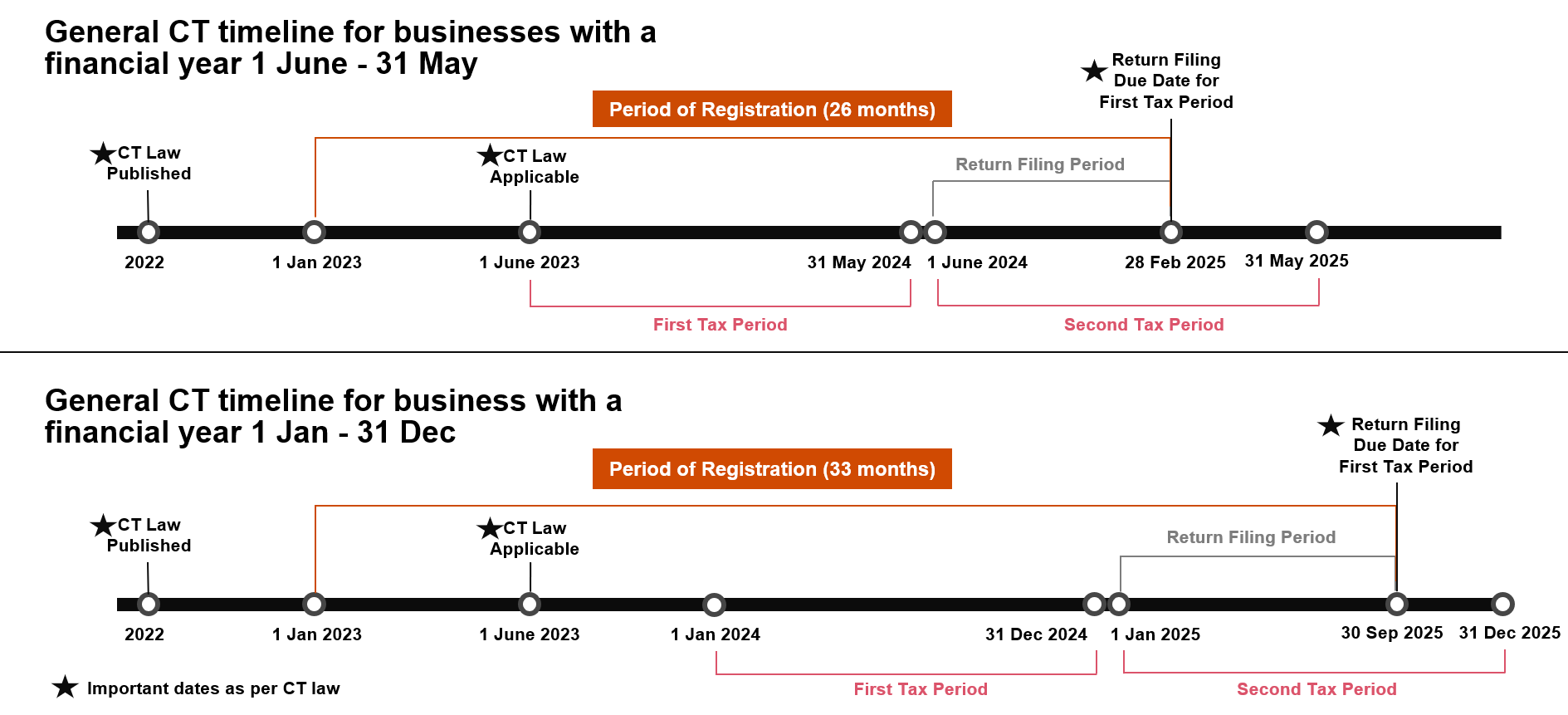
    Taxable Persons are required to file a Corporate Tax return for each Tax Period within 9 months from the end of the relevant period. The same deadline would generally apply for the payment of any Corporate Tax due in respect of the Tax Period for which a return is filed.

    Illustrated below are examples of the registration, filing and payment deadlines associated for Taxable Persons with a Tax Period (Financial Year) ending on 31 May or 31 December (respectively).

    filing and payment deadlines associated for Taxable Persons with a Tax Period (Financial Year) ending on 31 May or 31 December (respectively).

    How to prepare for Corporate Tax?

    1. Read the Corporate Tax Law and the supporting information available on the websites of the Ministry of Finance and the Federal Tax Authority.
    2. Use the available information to determine whether your business will be subject to Corporate Tax and if so, from what date.
    3. Understand the requirements for your business under the Corporate Tax Law, including, for example:
      1. Whether and by when your business needs to register for Corporate Tax;
      2. What is the accounting / Tax Period for your business;
      3. By when your business would need to file a Corporate Tax return;
      4. What elections or applications your business may or should make for Corporate Tax purposes;
      5. What financial information and records your business will need to keep for Corporate Tax purposes;
    4. Regularly check the websites of the Ministry of Finance and the Federal Tax Authority for further information and guidance on the Corporate Tax regime.

    Sources: FTA

    RSS Error: https://wealthcreatorhub.in/feed/ is invalid XML, likely due to invalid characters. XML error: Reserved XML Name at line 2, column 39
    Our Websites by Rohitashva Singhvi
  • UAE VAT Important FAQ

    UAE VAT Important FAQ

    What is VAT?

    VAT is a transaction-based indirect tax, which is charged and collected at each stage
    of the supply chain by legal and natural persons (“persons”) which meet the
    requirements to be registered for VAT.
    Thus, persons which are either registered or are required to register for VAT (known
    as “taxable persons”) charge VAT to their customers on taxable supplies of goods or
    services. A taxable supply is defined in the VAT legislation as a “supply of goods or
    services for a consideration by a person conducting business in the UAE, and does not
    include an exempt supply”. As a consequence, for a supply to be a taxable supply,
    the following conditions must be met:
    • there needs to be a supply of goods or services;
    • the supply has to be for consideration;
    • the supply has to be made by a person who is conducting business in the UAE;
    and
    • the supply should not be an exempt supply.
    Taxable supplies may either be subject to the standard rate of 5% or zero rate
    (i.e. 0%). A supply cannot be a taxable supply if it is an exempt supply. Where a supply
    is neither a taxable supply nor an exempt supply, it will be outside the scope of UAE
    VAT. VAT which taxable persons charge to their customers is known as “output tax”. On a
    periodic basis, taxable persons are required to account for output tax to the FTA. This
    is done by submitting a periodic tax return (also known as a “VAT return”).
    It should be noted that taxable persons will typically be charged VAT (known as “input
    tax”) by their suppliers when they acquire goods and services. Taxable persons are
    generally able to recover input tax, subject to certain conditions. Where the conditions
    allowing recovery of input tax are met, taxable persons are able to deduct this input
    tax from the value of output tax declared in the same VAT return.
    The difference between the output tax and input tax reported by a taxable person in
    their VAT returns is either the net VAT payable to the FTA (if the output tax exceeds
    the input tax) or net VAT recoverable from the FTA (if the input tax exceeds the output
    tax) for that specific tax return period.

    What are VAT registration requirements?
    VAT registration process as per below details:

    As mentioned above, a person is only required to account for VAT in the UAE, if it is
    a taxable person – that is, if the person is either registered for VAT or is obligated to
    register for VAT. It is, therefore, necessary to determine when a person is required to
    be registered for VAT.
    VAT registration may be either mandatory or voluntary. It should be noted that
    different registration requirements and conditions may apply to both mandatory and
    voluntary registrations depending on whether a person has a place of residence in the
    UAE. As a consequence, it is important for a person to know whether or not it is
    resident in the UAE when considering which registration rules apply to it.
    A person would have a place of residence in the UAE for the purposes of VAT
    registration if the person has a place of establishment or fixed establishment in the
    UAE. The terms are defined in the Decree-Law:4
    • “Place of Establishment” is the place where a business is legally established in
    a country pursuant to the decision of its establishment, in which significant
    management decisions are taken or central management functions are
    conducted.
    • “Fixed Establishment” is any fixed place of business, other than the Place of
    Establishment, in which the person conducts his business regularly or
    permanently and where sufficient human and technology resources exist to
    enable the person to supply or acquire goods or services, including the person’s
    branches.


    What are mandatory points for registration?
    A person resident in the UAE is required to register for VAT if any of the following
    apply:5
    • the total value of their taxable supplies made within the UAE and imports into
    the UAE exceeded AED 375,000 over the previous 12-month period; or
    • the person anticipates that the total value of their taxable supplies made within
    the UAE and imports into the UAE will exceed AED 375,000 in the next 30 days.
    Supplies of goods or services made in the UAE in the course of business.
    • Any goods or services that the person has imported into the UAE that would
    have been subject to VAT had they been supplied in the UAE.
    The person should not include in this calculation the value of any supplies which are
    either exempt from VAT or are outside the scope of UAE VAT.

    What does a business need to do to prepare for VAT?
    Businesses will need to meet certain requirements to fulfil their tax obligations. To fully comply with VAT, businesses will need to consider the VAT impact on their core operations, financial management and book-keeping, technology, and perhaps even their human resource mix (e.g., accountants and tax advisors). It is essential that businesses try to understand the implications of VAT and make every effort to align their business model to government reporting and compliance requirements.

    How will real estate be treated?

    The VAT treatment of real estate will depend on whether it is a commercial or residential property.

    Supplies (including sales or leases) of commercial properties will be taxable at the standard VAT rate (i.e 5%).

    On the other hand, supplies of residential properties will generally be exempt from VAT. This will ensure that VAT would not constitute an irrecoverable cost to persons who buy their own properties. In order to ensure that real estate developers can recover VAT on construction of residential properties, the first supply of residential properties (through sale or lease) within 3 years from their completion will be zero-rated.

    Will there be VAT grouping?
    Businesses that satisfy certain requirements covered under the Legislation (such as being resident in the UAE and being related/associated parties) will be able to register as a VAT group. VAT grouping would generally simplify accounting for VAT.

    How will insurance be treated?
    Generally, insurance (vehicle, medical, etc) is taxable. Life insurance, however, is an exempt service.

    How will financial services be treated?
    Fee based financial services are subject to VAT while margin based products are exempt.

    How will Islamic finance be treated?

    Islamic finance products are consistent with the principles of sharia and therefore often operate differently from financial products that are common internationally.

    To ensure that there are no inconsistencies between the VAT treatment of standard financial services and Islamic finance products, the treatment of Islamic finance products is aligned with the treatment of similar standard financial services.

    How quickly will refunds be released?
    Refunds will be made after the receipt of the application and subject to verification checks, with a particular focus on avoiding fraud.

    Will VAT be paid on imports?

    VAT is due on the goods and services purchased from abroad.

    In case the recipient in the State is a registered person with the Federal Tax Authority for VAT purposes, VAT would be due on that import using a reverse charge mechanism.

    In case the recipient in the State is a non-registered person for VAT purposes, VAT would need to be paid before the goods are released to the person.

    Will the goods exempt from customs duties also be exempt from VAT?
    No. Imported goods may be exempt from customs duties but still be subject to VAT.

    Will there be a profit margin scheme?
    To avoid double taxation where second hand goods are acquired by a registered person from an unregistered person for the purpose of resale, the VAT-registered person will be able to account for VAT on sales of second hand goods with reference to the difference between the purchase price of the goods and the sale price of the goods (that is, the profit margin). The VAT which must be accounted for by the registered person will be included in the profit margin. Further details of the conditions to be met in order to apply this mechanism can be found in the Executive Regulations of the Federal Decree-Law No.(8) of 2017 on Value Added Tax.

    What sectors will be zero rated?

    VAT will be charged at 0% in respect of the following main categories of supplies:

    Exports of goods and services to outside the GCC;
    International transportation, and related supplies;
    Supplies of certain sea, air and land means of transport (such as aircraft and ships);
    Certain investment grade precious metals (e.g. gold, silver, of 99% purity);
    Newly constructed residential properties, that are supplied for the first time within 3 years of their construction;
    Supply of certain education services, and supply of relevant goods and services;
    Supply of certain healthcare services, and supply of relevant goods and services.

    What are the categories of exempt supplies?

    The following categories of supplies will be exempt from VAT:

    The supply of some financial services;
    Residential properties (excluding the first supply of newly constructed residential property which qualifies for the zero-rating treatment);
    Bare land; and
    Local passenger transport.

    If you need to know more info then please refer FTA website.

    Thanks for reading, Stay Connected.


  • How to file UAE value added tax (‘VAT’) returns?

    How to file UAE value added tax (‘VAT’) returns?

    For submitting vat returns please read instructions below to simplify your work flow:

    This user instructions guide will help you understand the key steps to file a VAT Return online through the eServices portal. For each Tax Period, a Taxable Person will be required to submit a VAT
    Return which contains details regarding the supplies made or received by the Taxable Person.

    Main Points to be noted while return preparation:

    1. The standard Tax Period shall be a period of three calendar months ending on the
      date that the FTA determines.
    2. The FTA may, at its discretion, assign a different Tax Period other than the standard one, to a certain group of Taxable Persons.
    3. A Tax Return must be received by the FTA no later than the 28th day following the
      end of the Tax Period concerned or by such other date as directed by the FTA. Where
      a payment is due to the FTA, it must be received by the FTA by the same deadline.

    Filing VAT Returns:

    For each Tax Period, the Taxable Person shall report details in relation to sales and
    other outputs as well as purchases and other inputs. For details please refer to the VAT
    Returns full user guide. (You need to fill the details in prescribed format provided by FTA)

    Steps to complete the process of submitting a VAT Return Form
    > First step
    Login to the FTA eServices portal and go to the ‘VAT’ tab whereby you will be able
    to access your VAT Returns. From this screen you should click on the option to open
    your VAT Return.
    > Second step
    Complete the Form: Fill in the following details: (These points are included in second step)
    1. The sales and all other outputs as well as on expenses and all other inputs as
    follows:
    # the net amounts excluding VAT; and
    #the VAT amount;

    2. Based on your Payable Tax for the Tax Period proceed to a payment of any
    payable tax to the FTA or request (if you wish) a VAT refund; and

    3. Provide the additional reporting requirements in relation to the use of the Profit
    Margin Scheme during the relevant Tax Period.

    >Third Step
    Submit the Form: Ensure all the details must be verified as per FTA Guidelines.
    carefully review all of the information entered on the form after completing all mandatory
    fields and confirming the declaration. Once you confirm that all of the information included
    in the VAT Return is correct, click on the Submit button.

    >Fourth Step
    Pay the VAT Tax due (if applicable) through “My Payments” tab. Ensure payment
    deadlines are met.

    Here you go your, Your returns Filed.

    If you have any doubt then refer FTA website for more details.

    Hope this will help you to understand VAT submission in simple steps.

    Thanks for Reading, Stay Connected.


10 morning habits Embark on Your Writing Journey: A Beginner’s Guide Positive life with positive people mustreadbooks Business Startup