Tag: finance

  • Top 50 Financial Accounting Terms

    Top 50 Financial Accounting Terms

    Explore this helpful glossary of 50 important accounting terms that are essential for financial accounting. This list covers everything from basic accounting software to advanced financial analysis tools, providing easy-to-understand definitions. Whether you’re an accountant, business owner, or student, knowing these terms will help you manage finances more effectively.

    1. Financial Accounting Software:Software applications designed to record, store, and process financial transactions for businesses and organizations.
    2. Accounting ERP Systems:Enterprise Resource Planning (ERP) systems that integrate accounting functions with other core business processes like inventory management, human resources, and customer relationship management.
    3. Cloud Accounting Software:Accounting software hosted on remote servers, accessed through the internet, and offered on a subscription basis.
    4. Financial Statement Preparation:The process of compiling and presenting a company’s financial performance and position through balance sheets, income statements, and cash flow statements.
    5. Tax Preparation Software:Software that assists individuals and businesses in preparing and filing their tax returns.
    6. Payroll Software:Software used to automate the calculation, management, and distribution of employee wages and salaries.
    7. Financial Reporting Tools:Software applications designed to facilitate the creation, analysis, and distribution of financial reports.
    8. Financial Analysis Software:Tools used to evaluate financial data and assess the performance, profitability, and stability of a business.
    9. CPA Exam Review:Courses and materials designed to prepare candidates for the Certified Public Accountant (CPA) exam.
    10. Financial Advisor:A professional who provides financial advice and guidance to individuals and businesses.
    11. CFO Services:Outsourced Chief Financial Officer (CFO) services providing financial expertise and strategic planning for businesses.
    12. Financial Audit:An independent examination of a company’s financial records and statements to ensure accuracy and compliance with accounting standards.
    13. Internal Audit:An independent appraisal function within an organization to examine and evaluate its activities as a service to the organization.
    14. Forensic Accounting:The application of accounting principles and investigative techniques to gather evidence for legal proceedings.
    15. Financial Planning:The process of setting financial goals, developing strategies, and managing resources to achieve those goals.
    16. Investment Banking:A financial services sector that deals with the creation of capital for other companies, governments, and other entities.
    17. Asset Management: The professional management of various securities (shares, bonds, etc.) and other assets (e.g., real estate), to meet specified investment goals for the benefit of the investors.
    18. Corporate Finance: The area of finance dealing with the sources of funding and the capital structure of corporations, the actions that managers take to increase the value of the firm to the shareholders, and the tools and analysis used to allocate financial resources.
    19. Tax Accounting:The accounting for tax purposes, following the rules laid down by the tax authorities.
    20. Management Accounting: Also known as managerial accounting or cost accounting, it is the process of identifying, measuring, analyzing, interpreting, and communicating information for the pursuit of an organization’s goals.
    21. Government Accounting: The process of recording, analyzing, classifying, summarizing, communicating, and interpreting financial information about the government in aggregate and in detail reflecting transactions and other economic events involving the receipt, spending, transfer, usability, and disposition of assets and liabilities.
    22. Financial Modeling:The task of building an abstract representation (a model) of a real-world financial situation.
    23. Financial Forecasting:The process of estimating future financial outcomes for a company or country.
    24. Budgeting and Planning:The process of creating a plan to spend your money. This spending plan is called a budget.
    25. Variance Analysis:The quantitative investigation of the difference between actual and planned behavior.
    26. Financial Risk Management: The practice of identifying potential risks in advance, analyzing them and taking precautionary steps to reduce/curb the risk.
    27. Financial Compliance:The process of ensuring that companies are aware of and take steps to comply with relevant laws, policies, and regulations.
    28. Financial Fraud Investigation:The process of determining whether a fraud has occurred and if so, the perpetrator of the fraud.
    29. Accounting Standards (IFRS, GAAP): A common set of principles, standards, and procedures that define the basis of financial accounting policies and practices.
    30. Financial Statements (Balance Sheet, Income Statement, Cash Flow):A collection of summary-level reports about an organization’s financial results, financial position, and cash flows.
    31. Accounts Receivable Management:The process of managing money owed to a company by its debtors.
    32. Accounts Payable Management:The process of managing money owed by a company to its creditors.
    33. Inventory Management:The process of ordering, storing and using a company’s inventory: raw materials, components, and finished products.
    34. Fixed Asset Management:The process of managing a company’s physical assets, such as property, plant, and equipment.
    35. Financial Ratios:A relative magnitude of two selected numerical values taken from a company’s financial statements.
    36. Financial KPIs:A measurable value that demonstrates how effectively a company is achieving key business objectives.
    37. Bookkeeping Services: The recording of financial transactions, and is part of the process of accounting in business.
    38. Accounting Certifications (CPA, CMA, etc.):A professional certification of competency in the field of accounting.
    39. Financial Advisor Salary: The average salary for a financial advisor.
    40. Accounting Job Description: A formal account of an employee’s responsibilities.
    41. Accounting Career Path: The series of jobs that someone can have during their working life in the field of accounting.
    42. Accounting Education Requirements: The minimum level of education required for an accounting role.
    43. Accounting News: Information about recent events or happenings, especially as reported by newspapers, periodicals, radio, or television, related to the field of accounting.
    44. Accounting Blog: A discussion or informational website published on the World Wide Web consisting of discrete, often informal diary-style text entries (posts) related to the field of accounting.
    45. Accounting Podcast: A digital audio file made available on the Internet for downloading to a computer or mobile device, typically available as a series, new installments of which can be received by subscribers automatically, related to the field of accounting.
    46. Accounting Forum: An online message board where users can have conversations in the form of posted messages related to the field of accounting.
    47. Accounting Conferences:A meeting at which a specific topic is discussed, in this case accounting.
    48. Financial Statement Analysis: A method of reviewing and analyzing a company’s accounting reports (financial statements) in order to gauge its past, present or projected future performance.
    49. Depreciation:An accounting method of allocating the costof a tangible or physical asset over its useful life or life expectancy.
    50. Amortization: The paying off of debt with a fixed repayment schedule in regular installments over a period of time.

    Learning these 50 accounting terms is crucial for anyone in the financial field. From basic bookkeeping to advanced financial forecasting, this glossary gives you the knowledge you need to succeed in financial accounting. Use this list to make better business decisions, stay compliant with industry standards, and grow in your career. Save this glossary and refer to it whenever you need to refresh your understanding of important accounting concepts.

  • 5 Financial Habits to Avoid for a Secure Future

    5 Financial Habits to Avoid for a Secure Future

    In today’s fast-paced world, many people struggle with financial security. While some factors are beyond our control, certain habits can significantly impact our ability to build wealth and secure our financial future. Here are five common financial habits to avoid, along with tips on how to break them and set yourself on a path to financial success.

    1. Living Paycheck to Paycheck

    Living paycheck to paycheck is a common habit that makes it difficult to save money or build wealth. It creates a cycle where you spend most or all of your income without setting aside savings for emergencies or future goals. This approach leaves you vulnerable to unexpected expenses and financial stress.

    How to Break the Cycle:

    • Create a Budget: Outline your monthly income and expenses to understand where your money is going.
    • Set Financial Goals: Establish short-term and long-term savings goals to motivate you to save.
    • Build an Emergency Fund: Start with a small amount and gradually increase it until you have enough to cover at least three to six months’ worth of expenses.

    2. Impulse Spending

    Impulse spending can quickly drain your resources, leading to credit card debt and financial instability. It’s easy to buy things on a whim, but these purchases often add little value to your life and can hinder your ability to save.

    How to Reduce Impulse Spending:

    • Wait Before You Buy: Before making a purchase, wait 24 hours to see if it’s truly necessary.
    • Distinguish Wants from Needs: Ask yourself whether the item is a “want” or a “need.” Focus on fulfilling your needs first.
    • Track Your Spending: Keep a record of your expenses to identify patterns of impulse spending.

    3. Ignoring Your Budget (or Not Having One)

    A budget is a crucial tool for managing your finances. Without one, it’s easy to overspend or lose track of where your money goes. This can lead to financial stress and hinder your ability to save.

    How to Create and Stick to a Budget:

    • Choose a Budgeting Method: Explore different budgeting methods (like the 50/30/20 rule) and choose one that works for you.
    • Review Your Budget Regularly: Adjust your budget as your income or expenses change.
    • Use Budgeting Tools: Consider using apps or software to help you manage your budget more effectively.

    4. High-Interest Debt

    Credit cards and loans can be useful, but high interest rates can quickly trap you in a cycle of debt. Carrying high-interest debt can drain your resources and limit your ability to invest or save for the future.

    Strategies to Manage High-Interest Debt:

    • Prioritize Debt Repayment: Focus on paying down high-interest debts first, such as credit cards.
    • Consider Debt Consolidation: If you have multiple high-interest debts, consider consolidating them into a lower-interest loan.
    • Limit Credit Card Use: Use credit cards responsibly and avoid carrying a balance if possible.

    5. Not Investing for the Future

    Investing is a powerful way to grow your wealth over time. By not investing, you miss out on the potential benefits of compound interest and the opportunity to secure your financial future.

    How to Start Investing:

    • Start Small: Begin with small contributions to a retirement account or an investment portfolio.
    • Take Advantage of Employer Benefits: If your employer offers a retirement plan with matching contributions, be sure to take advantage of it.
    • Diversify Your Investments: Spread your investments across different asset classes to reduce risk.

    By avoiding these common financial habits and adopting healthier practices, you can take control of your finances and work toward a more secure future. Focus on mindful spending, consistent saving, and strategic investing to build the financial stability you desire.

    Also grab the right knowledge from these books : 10 Best Books for Improvement in your Life

  • Accrual Basis of Accounting: Recognizing Revenue and Expenditure

    Accrual Basis of Accounting: Recognizing Revenue and Expenditure

    In the realm of finance and accounting, the accrual basis stands as a cornerstone principle, guiding the recognition of revenue and expenditure. Unlike cash basis accounting, which records transactions when cash is exchanged, the accrual basis focuses on when revenue is earned or expenses are incurred, regardless of the timing of cash flows or invoice issuance. Let’s delve into this essential concept to grasp its significance in financial reporting.

    Recognizing Revenue and Expenditure

    Under the accrual basis of accounting, revenue and expenditure are acknowledged when they are earned or incurred, respectively. This means that transactions are recorded as they occur, reflecting the economic reality of business activities rather than the timing of cash movements.

    For instance, imagine a scenario where a service provider delivers services to a customer, but payment is not received until a later date. Despite the delay in payment, revenue is recognized when the service is provided, aligning with the accrual basis principle.

    Example 1: Revenue Recognition

    Consider Company X, with a financial year ending on April 30. On April 5, 2025, Company X provides consulting services worth AED 12,000 to Customer A. Although the invoice is sent on May 10 and payment is received on June 15, revenue should be recognized on April 5, the date of service delivery. This ensures that revenue is recorded in the appropriate financial period, irrespective of invoice issuance or payment receipt.

    Example 2: Expense Recognition

    Continuing from the previous example, let’s examine expense recognition. Customer A, with a financial year also ending on April 30, incurs an expense when receiving services from Company X on April 5, 2025. Even if the invoice is received later or payment is made after the service, the expense should be recognized on April 5, aligning with the accrual basis principle.

    The Significance

    Embracing the accrual basis of accounting offers several advantages. Firstly, it provides a more accurate depiction of a company’s financial position by matching revenues with corresponding expenses, thus reflecting the true profitability of operations. Additionally, it enables better comparability across different accounting periods, facilitating informed decision-making for stakeholders.

    In conclusion, understanding the accrual basis of accounting is paramount for businesses aiming to maintain transparency and accuracy in financial reporting. By recognizing revenue and expenditure when earned or incurred, rather than when cash transactions occur, companies can present a more comprehensive and reliable representation of their financial performance.

  • Understanding IFRS 16

    Understanding IFRS 16

    The International Financial Reporting Standard (IFRS) 16, which took effect in January 2019, has brought a transformative approach to how companies account for leases. This new standard has several key objectives, which include:

    • Providing Transparency: Ensuring that financial statements accurately reflect lease transactions.
    • Informing Decision-Making: Equipping investors and stakeholders with the necessary information to assess the financial implications of leases.

    In essence, IFRS 16 mandates that lessees (the party using a leased asset) must recognize most leases on their balance sheets. This involves recording an asset (the right-of-use) and a liability (the lease payments). This change has significant financial impacts, particularly for industries heavily dependent on leasing, such as airlines, retailers, and manufacturers.

    Key Changes Introduced by IFRS 16

    Single Accounting Model

    IFRS 16 replaces the previous dual model of lease accounting, which differentiated between operating and finance leases, with a single model for lessees. This change simplifies the accounting process but requires the recognition of most leases, which were previously off the balance sheet if classified as operating leases.

    Recognition Threshold

    Under IFRS 16, leases that extend beyond 12 months or involve assets of significant value must be recognized on the balance sheet. This eliminates the off-balance-sheet treatment previously allowed for operating leases, thereby increasing transparency and accuracy in financial reporting.

    Right-of-Use Assets & Lease Liabilities

    Lessees are now required to record a right-of-use asset, representing their right to use the leased asset, and a corresponding lease liability, representing their obligation to make lease payments. This recognition has widespread implications for financial statements and ratios.

    Evolution of Lease Accounting Standards

    The journey to IFRS 16 has been extensive, with the International Accounting Standards Board (IASB) continuously refining lease accounting standards over the years:

    • IAS 17 (1997): Introduced the original standard with the dual model for lease accounting, later revised in 2003.
    • SIC Interpretations (1998-2004): Addressed specific complexities and nuances of lease transactions.
    • IFRIC 4 (2004): Provided clarity on whether certain arrangements constitute leases.
    • IFRS 16 (2016): The current standard, replacing all previous standards and marking a significant shift in lease accounting.

    Recent Amendments to IFRS 16

    The IASB has issued several amendments to IFRS 16 to address specific situations and ensure the standard remains relevant and effective:

    • Covid-19-Related Rent Concessions (2020): Provided lessees with more flexibility in accounting for rent reductions due to the pandemic.
    • Interest Rate Benchmark Reform (2020): Addressed changes in interest rate benchmarks and their impact on lease accounting.
    • Lease Liability in a Sale and Leaseback (2022): Added guidance on the subsequent measurement for these transactions.

    Practical Implications for Businesses

    The implementation of IFRS 16 has far-reaching implications for businesses across various sectors:

    Financial Statements

    The requirement to recognize leases on the balance sheet results in increased assets and liabilities. This change enhances transparency but also requires companies to adjust their financial reporting processes.

    Financial Ratios

    Key financial ratios, such as debt-to-equity and return on assets, are impacted by the increased recognition of lease liabilities and right-of-use assets. This can affect how investors and stakeholders view the financial health of a company.

    Debt Covenants

    The increased liabilities recognized under IFRS 16 can lead to potential breaches of loan agreements that contain debt covenants. Companies may need to renegotiate these covenants to reflect the new accounting standards.

    Internal Systems

    To comply with IFRS 16, businesses need to update their internal accounting systems and processes. This includes training staff, modifying software, and ensuring that lease data is accurately captured and reported.

    Benefits of IFRS 16

    While IFRS 16 brings several challenges, it also offers significant benefits:

    Enhanced Transparency

    By recognizing leases on the balance sheet, IFRS 16 provides a clearer picture of a company’s financial obligations. This enhanced transparency aids investors and stakeholders in making more informed decisions.

    Improved Comparability

    The single accounting model for lessees under IFRS 16 ensures consistency in financial reporting across companies. This improved comparability helps stakeholders assess the financial performance of different entities more accurately.

    Better Decision-Making

    With more accurate financial information, businesses can make better strategic decisions. Understanding the true cost of leasing helps companies evaluate lease versus buy decisions and manage their resources more effectively.

    Challenges in Implementing IFRS 16

    Implementing IFRS 16 can be challenging for businesses, especially those with a large volume of leases. Some of the key challenges include:

    Data Collection and Management

    Accurately capturing and managing lease data is critical for compliance with IFRS 16. Businesses need to ensure that all relevant lease information is gathered, stored, and updated regularly.

    Systems and Processes

    Updating internal systems and processes to comply with IFRS 16 can be time-consuming and costly. Companies may need to invest in new software or modify existing systems to handle the requirements of the new standard.

    Training and Awareness

    Staff training and awareness are crucial for the successful implementation of IFRS 16. Employees involved in lease accounting need to be well-versed in the new standard and understand its implications for financial reporting.

    Sector-Specific Impacts

    Different industries are affected by IFRS 16 in various ways. Here are some examples:

    Airlines

    Airlines, which typically have significant lease obligations for aircraft, see a substantial increase in reported assets and liabilities. This impacts their financial ratios and may affect their ability to secure financing.

    Retailers

    Retailers with numerous leased stores also experience significant changes in their financial statements. The increased liabilities can affect their debt covenants and borrowing capacity.

    Manufacturers

    Manufacturers that lease equipment or facilities face similar challenges. The need to recognize these leases on the balance sheet can impact their financial ratios and overall financial health.

    Best Practices for Compliance

    To ensure compliance with IFRS 16, businesses can follow these best practices:

    Conduct a Thorough Assessment

    Conduct a comprehensive assessment of all leases to determine which ones need to be recognized on the balance sheet. This involves reviewing lease agreements and identifying any embedded leases.

    Update Systems and Processes

    Ensure that internal systems and processes are capable of handling the requirements of IFRS 16. This may involve investing in new software or modifying existing systems to capture lease data accurately.

    Train Staff

    Provide training to staff involved in lease accounting to ensure they understand the new standard and its implications. This includes both accounting personnel and those involved in negotiating and managing leases.

    Monitor and Review

    Regularly monitor and review lease data to ensure ongoing compliance with IFRS 16. This involves updating lease information as needed and ensuring that financial statements accurately reflect lease obligations.

    Final Words

    IFRS 16 represents a significant change in lease accounting. While it aims to improve transparency and comparability in financial reporting, it also brings challenges for businesses. Understanding the standard’s requirements and implications is crucial for accurate financial reporting and informed decision-making.

    Businesses need to take a proactive approach to ensure compliance with IFRS 16. By conducting a thorough assessment of leases, updating systems and processes, providing staff training, and monitoring lease data regularly, companies can navigate the complexities of the new standard and reap its benefits.

    Implementing IFRS 16 may require substantial effort, but the enhanced transparency and improved decision-making it offers can ultimately lead to better financial management and more informed strategic choices.

    In the context of the UAE, where the economy is diverse and rapidly growing, adherence to IFRS 16 is essential for maintaining investor confidence and ensuring that businesses remain competitive on the global stage. As companies in the UAE continue to expand and engage in international markets, compliance with international financial reporting standards like IFRS 16 will play a crucial role in their success.

    By embracing the changes brought by IFRS 16, businesses in the UAE can enhance their financial reporting, improve transparency, and make more informed decisions, ultimately contributing to their long-term growth and success.

    Latest news on IFRS: The Changing Tides: New IFRS Accounting Standards Effective from 1 January 2024 – Rohitashva Singhvi

  • The Changing Tides: New IFRS Accounting Standards Effective from 1 January 2024

    The Changing Tides: New IFRS Accounting Standards Effective from 1 January 2024

    Published: December 8, 2023

    As we approach the dawn of a new accounting era, the International Financial Reporting Standards (IFRS) have undergone significant updates, ushering in changes that will reshape financial reporting for entities across the globe. Effective from 1 January 2024, these amendments aim to enhance transparency, address concerns raised by investors, and refine the accounting treatment for various transactions. In this blog post, we delve into the key amendments that entities need to be cognizant of in their financial reporting.

    GX Year End Reminders

    Paragraph 30 of IAS 8 mandates entities to disclose information about new accounting standards not yet effective, providing insights into the potential impact on their financial statements. Our summary encapsulates all new accounting standards and amendments issued up to 31 December 2023, applicable for accounting periods starting on or after 1 January 2024.

    Amendment to IFRS 16 – Leases on Sale and Leaseback

    The amendments to IFRS 16 introduce requirements addressing sale and leaseback transactions, specifically focusing on how entities should account for such transactions post the transaction date. Notably, sale and leaseback transactions featuring variable lease payments unrelated to an index or rate are likely to experience the most significant impact. For detailed guidance, refer to IFRS Manual of Accounting paragraph 15.155.1.

    • Published: September 2022
    • Effective Date: Annual periods beginning on or after 1 January 2024.

    Amendment to IAS 1 – Non-current Liabilities with Covenants

    These amendments to IAS 1 bring clarity to the impact of conditions that an entity must comply with within twelve months after the reporting period on the classification of a liability. The primary objective is to enhance the information provided by entities regarding liabilities subject to these conditions. Further insights can be found in In brief INT2022-16.

    • Published: January 2020 and November 2022
    • Effective Date: Annual periods beginning on or after 1 January 2024.

    Amendment to IAS 7 and IFRS 7 – Supplier Finance

    In response to investor concerns about the opacity of supplier finance arrangements, the amendments to IAS 7 and IFRS 7 mandate enhanced disclosures. These requirements aim to provide transparency on the effects of supplier finance arrangements on an entity’s liabilities, cash flows, and exposure to liquidity risk. For more details, refer to In brief INT2023-03.

    • Published: May 2023
    • Effective Date: Annual periods beginning on or after 1 January 2024 (with transitional reliefs in the first year).

    Amendments to IAS 21 – Lack of Exchangeability

    Entities with transactions or operations in a foreign currency that is not exchangeable at the measurement date for a specified purpose will be impacted by the amendments to IAS 21. Exchangeability is defined as the ability to obtain another currency with a normal administrative delay, and the transaction occurs through a market or exchange mechanism creating enforceable rights and obligations. Early adoption is available.

    • Published: August 2023
    • Effective Date: Annual periods beginning on or after 1 January 2025 (early adoption is available).

    As entities gear up for the implementation of these new IFRS accounting standards, proactive measures and a thorough understanding of the amendments will be crucial. It is imperative for financial professionals and organizations to stay abreast of these changes, ensuring a seamless transition into the evolving landscape of international financial reporting. The effective management of these standards will not only ensure compliance but also contribute to the credibility and transparency of financial statements in an ever-changing economic environment.

  • A Deep Dive into the UAE Corporate Tax & Currency Conversion Guidelines

    A Deep Dive into the UAE Corporate Tax & Currency Conversion Guidelines

    In June 2023, the United Arab Emirates (UAE) witnessed a significant shift in its economic landscape with the introduction of the Corporate Tax. For businesses operating in the region, understanding and adhering to the associated guidelines became paramount. In this blog post, we’ll unravel the intricacies of these guidelines, providing businesses with a comprehensive roadmap to navigate the UAE’s tax framework.

    1. Calculate Taxable Income:

    The journey begins with calculating your company’s taxable income—a fundamental step in the tax process. Businesses must meticulously determine their profits after factoring in allowable deductions and expenses. The guidelines offer clarity on which expenses are deductible and provide insights into handling unique situations, such as foreign income and free zone operations.

    1. Apply the Tax Rate:

    Once your taxable income is established, the next step is applying the tax rate. The standard corporate tax rate in the UAE stands at 9%. However, exemptions and reduced rates are applicable to certain entities. Understanding this is crucial, as it determines the percentage of your taxable income that will be allocated to tax obligations.

    1. Convert Foreign Currency Transactions:

    Operating in a global economy often involves dealing with multiple currencies. For tax purposes, the UAE dirham (AED) is the official currency, necessitating the conversion of foreign transactions into AED. This involves utilizing exchange rates set by the authorities to translate the value of income earned in other currencies into AED for accurate tax calculations.

    1. Comply with Reporting and Payment Requirements:

    Fulfilling reporting and payment obligations marks the final leg of this journey. The guidelines meticulously outline deadlines and procedures for electronically filing tax returns and making timely tax payments. Compliance at this stage ensures businesses meet their tax obligations accurately and within the stipulated time frames.

    Additional Considerations:

    Given the novelty of these guidelines, businesses should remain vigilant for any further clarifications or updates from the authorities. Staying informed is key, and consulting with qualified tax professionals is strongly advised to ensure continued compliance with the evolving tax landscape.

    Remember:

    It’s important to note that this information serves as a general guide and does not constitute financial or tax advice. Businesses are encouraged to seek professional guidance to address their specific circumstances and ensure compliance with the UAE Corporate Tax & Currency Conversion Guidelines.

    Conclusion:

    In conclusion, these guidelines serve as a compass for businesses navigating the complex terrain of the UAE Corporate Tax. By understanding and implementing these steps, companies can not only meet their tax obligations but also contribute to the economic stability and growth of the UAE. Stay informed, seek professional advice, and embark on this journey with confidence and compliance.

  • The Distinctions Between “Made in UAE” and “Manufactured in UAE”

    The Distinctions Between “Made in UAE” and “Manufactured in UAE”

    Advertisement:

    When it comes to products labeled as “made in UAE” or “manufactured in UAE,” the differences may seem minimal, but understanding the nuances can provide valuable insights into the origin and production processes. In this blog post, we’ll explore the subtle distinctions between these terms and shed light on their implications for consumers.

    Formal vs. Informal Connotations: At first glance, both phrases convey that a product underwent assembly and finishing in the United Arab Emirates, meeting the criteria for classification as a UAE-made good. However, “made in UAE” holds a more formal connotation and is often associated with the official “Made in UAE” mark, a government-issued certification scheme for locally manufactured products. This emblem signifies that the product underwent specific quality control checks and adheres to requirements regarding local content and value addition. On the other hand, “manufactured in UAE” is more informal and is generally used as a broad statement of origin.

    Emphasis on Production Process: The choice between these terms can subtly emphasize different aspects of the production process. “Manufactured in UAE” tends to highlight the actual production and assembly occurring within the UAE. Meanwhile, “made in UAE” encompasses these processes but also implies broader ownership and responsibility over the product’s creation within the country.

    Legality Considerations: In certain cases, legal considerations may influence the preference for one term over the other, depending on specific trade agreements or regulations. However, for most general consumer purposes, these terms are often used interchangeably.

    Conclusion: In conclusion, whether a product is labeled “made in UAE” or “manufactured in UAE,” both phrases essentially communicate the same message: the product was created and finished in the United Arab Emirates. The choice between the two depends on the context and the desired level of formality. Understanding these subtle differences can empower consumers to make more informed choices when navigating the world of UAE-made goods.

    We hope this clarification proves helpful. Should you have any further questions, feel free to reach out.

  • Economic Substance Requirements in the UAE: A Comprehensive Guide

    Economic Substance Requirements in the UAE: A Comprehensive Guide

    In the dynamic business landscape of the United Arab Emirates (UAE), understanding and complying with economic substance regulations is paramount for companies engaged in specific activities. Economic substance goes beyond a mere paper trail, requiring companies to establish a genuine and substantial commercial presence within the country. In this blog post, we will delve into the registration process, key considerations, and available resources to help you navigate the intricate framework of economic substance requirements in the UAE.

    Registration Process:

    Identifying Relevant Activities:

    The first crucial step is determining whether your company is involved in any of the “Relevant Activities” outlined by the UAE Ministry of Finance. These include, but are not limited to:

    • Banking
    • Insurance
    • Investment Management
    • Lease-financing
    • Headquarters
    • Shipping
    • Holding Company
    • Intellectual Property
    • Distribution and Service Centers

    Economic Substance Test:

    Companies engaged in relevant activities must undergo the “Economic Substance Test” to validate their substantial economic presence. The test comprises three key components:

    1. Directed and Managed in the UAE: Key decisions and management functions must originate from within the UAE.
    2. Core Income Generating Activities (CIGA) conducted in the UAE: The activities generating the core income must take place within the UAE.
    3. Adequate People, Premises, and Expenditure: The company should have sufficient personnel, office space, and resources in the UAE to support the activities.

    Notification and Reporting:

    All companies involved in relevant activities, irrespective of their economic substance test results, are required to submit an annual notification to the Federal Tax Authority (FTA). Companies failing the test must furnish a detailed Economic Substance Report outlining their circumstances and potential measures for compliance improvement.

    Types of Companies Subject to Registration:

    The economic substance regulations apply to:

    1. Onshore and Free Zone Companies: All UAE-registered companies engaged in relevant activities, whether onshore or in free zones.
    2. Branches of Foreign Companies: Foreign company branches operating in the UAE and conducting relevant activities must also adhere to these regulations.
    3. Representative Offices: Although representative offices typically do not generate income, they may need to register if involved in substantive activities related to relevant activities.

    Exemptions:

    Certain exemptions exist, such as companies with specific licenses or those solely managing their investments. However, it is advisable to consult with a qualified tax advisor to ascertain your unique situation and compliance requirements.

    Resources:

    To stay informed and ensure compliance, refer to the following resources:

    • Ministry of Finance Economic Substance Regulations: Link
    • Federal Tax Authority Economic Substance Guidelines: Link
    • PwC guide to UAE Economic Substance Regulations: Link

    Conclusion:

    Adhering to economic substance regulations is essential to avoid penalties and potential disruptions in your business operations within the UAE. For personalized advice and guidance tailored to your specific circumstances, consider seeking professional assistance from a tax advisor or financial expert. If you have any questions or require further clarification, feel free to reach out for expert support.

    Thanks for Reading.

  • UAE Corporate Tax – All in one basic info

    UAE Corporate Tax – All in one basic info

    What is Corporate Tax?

    Corporate Tax is a form of direct tax levied on the net income of corporations and other businesses.

    Corporate Tax is sometimes also referred to as “Corporate Income Tax” or “Business Profits Tax” in other jurisdictions.

    Who is subject to Corporate Tax?

    Broadly, Corporate Tax applies to the following “Taxable Persons”:

    • UAE companies and other juridical persons that are incorporated or effectively managed and controlled in the UAE;
    • Natural persons (individuals) who conduct a Business or Business Activity in the UAE as specified in a Cabinet Decision to be issued in due course; and
    • Non-resident juridical persons (foreign legal entities) that have a Permanent Establishment in the UAE (which is explained under [Section 8]).

    Juridical persons established in a UAE Free Zone are also within the scope of Corporate Tax as “Taxable Persons” and will need to comply with the requirements set out in the Corporate Tax Law. However, a Free Zone Person that meets the conditions to be considered a Qualifying Free Zone Person can benefit from a Corporate Tax rate of 0% on their Qualifying Income (the conditions are included in [Section 14]).

    Non-resident persons that do not have a Permanent Establishment in the UAE or that earn UAE sourced income that is not related to their Permanent Establishment may be subject to Withholding Tax (at the rate of 0%). Withholding tax is a form of Corporate Tax collected at source by the payer on behalf of the recipient of the income. Withholding taxes exist in many tax systems and typically apply to the cross-border payment of dividends, interest, royalties and other types of income.

    Who is exempt from Corporate Tax?

    Certain types of businesses or organisations are exempt from Corporate Tax given their importance and contribution to the social fabric and economy of the UAE. These are known as Exempt Persons and include:

    Automatically exempt●     Government Entities●     Government Controlled Entities that are specified in a Cabinet Decision
    Exempt if notified to the Ministry of Finance (and subject to meeting certain conditions)●     Extractive Businesses●     Non-Extractive Natural Resource Businesses
    Exempt if listed in a Cabinet Decision●     Qualifying Public Benefit Entities
    Exempt if applied to and approved by the Federal Tax Authority (and subject to meeting  certain conditions)●     Public or private pension and social security funds●     Qualifying Investment Funds●     Wholly-owned and controlled UAE subsidiaries of a Government Entity, a Government Controlled Entity, a Qualifying Investment Fund, or a public or private pension or social security fund

    In addition to not being subject to Corporate Tax, Government Entities, Government Controlled Entities that are specified in a Cabinet Decision, Extractive Businesses and Non-Extractive Natural Resource Businesses may also be exempted from any registration, filing and other compliance obligations imposed by the Corporate Tax Law, unless they engage in an activity which is within the charge of Corporate Tax.

    How is a Taxable Person subject to Corporate Tax?

    In line with the tax regimes of most countries, the Corporate Tax Law taxes income on both a residence and source basis. The applicable basis of taxation depends on the classification of the Taxable Person.

    • A “Resident Person” is taxed on income derived from both domestic and foreign sources (i.e. a residence basis).
    • A “Non-Resident Person” will be taxed only on income derived from sources within the UAE (i.e. a source basis).

    Residence for Corporate Tax purposes is not determined by where a person resides or is domiciled but instead by specific factors that are set out in the Corporate Tax Law.  If a Person does not satisfy the conditions for being either a Resident or a Non-Resident person then they will not be a Taxable Person and will not therefore be subject to Corporate Tax.

    Who is a Resident Person?

    Companies and other juridical persons that are incorporated or otherwise formed or recognised under the laws of the UAE will automatically be considered a Resident Person for Corporate Tax purposes. This covers juridical persons incorporated in the UAE under either mainland legislation or applicable Free Zone regulations, and would also include juridical persons created by a specific statute (e.g. by a special decree).

    Foreign companies and other juridical persons may also be treated as Resident Persons for Corporate Tax purposes where they are effectively managed and controlled in the UAE. This shall be determined with regard to the specific circumstances of the entity and its activities, with a determining factor being where key management and commercial decisions are in substance made.

    Natural persons will be subject to Corporate Tax as a “Resident Person” on income from both domestic and foreign sources, but only insofar as such income is derived from a Business or Business Activity conducted by the natural person in the UAE. Any other income earned by a natural person would not be within the scope of Corporate Tax.

    Who is a Non-Resident Person?

    Non-Resident Persons are juridical persons who are not Resident Persons and:

    • have a Permanent Establishment in the UAE; or
    • derive State Sourced Income.

    Non-Resident Persons will be subject to Corporate Tax on Taxable Income that is attributable to their Permanent Establishment (which is explained under Section 8).

    Certain UAE sourced income of a Non-Resident Person that is not attributable to a Permanent Establishment in the UAE will be subject to Withholding Tax at the rate of 0%.

    What is a Permanent Establishment?

    The concept of Permanent Establishment is an important principle of international tax law used in corporate tax regimes across the world. The main purpose of the Permanent Establishment concept in the UAE Corporate Tax Law is to determine if and when a foreign person has established sufficient presence in the UAE to warrant the business profits of that foreign person to be subject to Corporate Tax.

    The definition of Permanent Establishment in the Corporate Tax Law has been designed on the basis of the definition provided in Article 5 of the OECD Model Tax Convention on Income and Capital and the position adopted by the UAE under the Multilateral Instrument to Implement Tax Treaty Related Measures to Prevent Base Erosion and Profit Shifting. This allows foreign persons to use the relevant Commentary of Article 5 of the OECD Model Tax Convention when assessing whether they have a Permanent Establishment or not in the UAE. This assessment should consider the provisions of any bilateral tax agreement between the country of residence of the Non-Resident Person and the UAE. 

    What is Corporate Tax imposed on?

    Corporate Tax is imposed on Taxable Income earned by a Taxable Person in a Tax Period.

    Corporate Tax would generally be imposed annually, with the Corporate Tax liability calculated by the Taxable Person on a self-assessment basis. This means that the calculation and payment of Corporate Tax is done through the filing of a Corporate Tax Return with the Federal Tax Authority by the Taxable Person.

    The starting point for calculating Taxable Income is the Taxable Person’s accounting income (i.e. net profit or loss before tax) as per their financial statements. The Taxable Person will then need to make certain adjustments to determine their Taxable Income for the relevant Tax Period. For example, adjustments to accounting income may need to be made for income that is exempt from Corporate Tax and for expenditure that is wholly or partially non-deductible for Corporate Tax purposes.

    What income is exempt?

    The Corporate Tax Law also exempts certain types of income from Corporate Tax. This means that a Taxable Persons will not be subject to Corporate Tax on such income and cannot claim a deduction for any related expenditure. Taxable Persons who earn exempt income will remain subject to Corporate Tax on their Taxable Income.

    The main purpose of certain income being exempt from Corporate Tax is to prevent double taxation on certain types of income. Specifically, dividends and capital gains earned from domestic and foreign shareholdings will generally be exempt from Corporate Tax. Furthermore, a Resident Person can elect, subject to certain conditions, to not take into account income from a foreign Permanent Establishment for UAE Corporate Tax purposes.

    What expenses are deductible?

    In principle, all legitimate business expenses incurred wholly and exclusively for the purposes of deriving Taxable Income will be deductible, although the timing of the deduction may vary for different types of expenses and the accounting method applied. For capital assets, expenditure would generally be recognised by way of depreciation or amortisation deductions over the economic life of the asset or benefit.

    Expenditure that has a dual purpose, such as expenses incurred for both personal and business purposes, will need to be apportioned with the relevant portion of the expenditure treated as deductible if incurred wholly and exclusively for the purpose of the taxable person’s business.

    Certain expenses which are deductible under general accounting rules may not be fully deductible for Corporate Tax purposes. These will need to be added back to the Accounting Income for the purposes of determining the Taxable Income. Examples of expenditure that is or may not be deductible (partially or in full) include:

    Types of ExpendituresLimitation to deductibility
    BribesFines and penalties (other than amounts awarded as compensation for damages or breach of contract)Donations, grants or gifts made to an entity that is not a Qualifying Public Benefit EntityDividends and other profits distributionsCorporate Tax imposed under the Corporate Tax LawExpenditure not incurred wholly and exclusively for the purposes of the Taxable person’s BusinessExpenditure incurred in deriving income that is exempt from Corporate TaxNo deduction
    Client entertainment expenditurePartial deduction of 50% of the amount of the expenditure
    Interest expenditureDeduction of net interest expenditure exceeding a certain de minimis thresholdup to 30% of the amount of earnings before the deduction of interest, tax, depreciation and amortisation (except for certain activities)

    What is the Corporate Tax rate?

    Corporate Tax will be levied at a headline rate of 9% on Taxable Income exceeding AED 375,000. Taxable Income below this threshold will be subject to a 0% rate of Corporate Tax.

    Corporate Tax will be charged on Taxable Income as follows:

    Resident Taxable Persons
    Taxable Income not exceeding AED 375,000(this amount is to be confirmed in a Cabinet Decision)0%
    Taxable Income exceeding AED 375,0009%
    Qualifying Free Zone Persons
    Qualifying Income0%
    Taxable Income that does not meet the Qualifying Income definition9%

    What is the Withholding Tax rate?

    A 0% withholding tax may apply to certain types of UAE sourced income paid to non-residents. Because of the 0% rate, in practice, no withholding tax would be due and there will be no withholding tax related registration and filing obligations for UAE businesses or foreign recipients of UAE sourced income.

    Withholding tax does not apply to transactions between UAE resident persons.

    When can a Free Zone Person be a Qualifying Free Zone Person?

    A Free Zone Person that is a Qualifying Free Zone Person can benefit from a preferential Corporate Tax rate of 0% on their “Qualifying Income” only.

    In order to be considered a Qualifying Free Zone Person, the Free Zone Person must:

    • maintain adequate substance in the UAE;
    • derive ‘Qualifying Income’;
    • not have made an election to be subject to Corporate Tax at the standard rates; and
    • comply with the transfer pricing requirements under the Corporate Tax Law.

    The Minister may prescribe additional conditions that a Qualifying Free Zone Person must meet.

    If a Qualifying Free Zone Person fails to meet any of the conditions, or makes an election to be subject to the regular Corporate Tax regime, they will be subject to the standard rates of Corporate Tax from the beginning of the Tax Period where they failed to meet the conditions.

    What are Tax Groups, and when can they be formed?

    Two or more Taxable Persons who meet certain conditions (see below) can apply to form a “Tax Group” and be treated as a single Taxable Person for Corporate Tax purposes.

    To form a Tax Group, both the parent company and its subsidiaries must be resident juridical persons, have the same Financial Year and prepare their financial statements using the same accounting standards.

    Additionally, to form a Tax Group, the parent company must:

    • own at least 95% of the share capital of the subsidiary;
    • hold at least 95% of the voting rights in the subsidiary; and
    • is entitled to at least 95% of the subsidiary’s profits and net assets.

    The ownership, rights and entitlement can be held either directly or indirectly through subsidiaries, but a Tax Group cannot include an Exempt Person or Qualifying Free Zone Person.

    How to calculate the Taxable Income of a Tax Group?

    To determine the Taxable Income of a Tax Group, the parent company must prepare consolidated financial accounts covering each subsidiary that is a member of the Tax Group for the relevant Tax Period. Transactions between the parent company and each group member and transactions between the group members would be eliminated for the purposes of calculating the Taxable Income of the Tax Group. 

    Registering, filing and paying Corporate Tax

    All Taxable Persons (including Free Zone Persons) will be required to register for Corporate Tax and obtain a Corporate Tax Registration Number. The Federal Tax Authority may also request certain Exempt Persons to register for Corporate Tax.

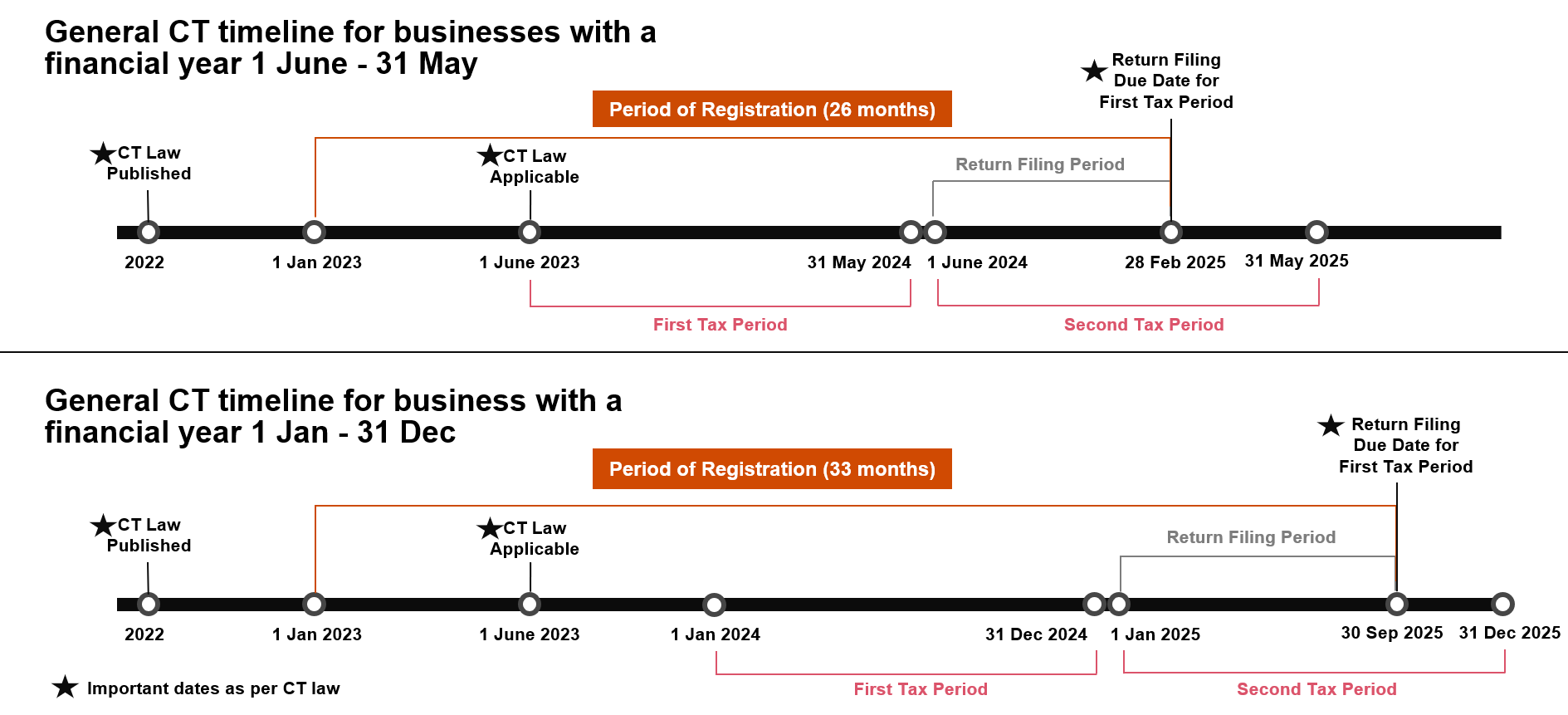
    Taxable Persons are required to file a Corporate Tax return for each Tax Period within 9 months from the end of the relevant period. The same deadline would generally apply for the payment of any Corporate Tax due in respect of the Tax Period for which a return is filed.

    Illustrated below are examples of the registration, filing and payment deadlines associated for Taxable Persons with a Tax Period (Financial Year) ending on 31 May or 31 December (respectively).

    filing and payment deadlines associated for Taxable Persons with a Tax Period (Financial Year) ending on 31 May or 31 December (respectively).

    How to prepare for Corporate Tax?

    1. Read the Corporate Tax Law and the supporting information available on the websites of the Ministry of Finance and the Federal Tax Authority.
    2. Use the available information to determine whether your business will be subject to Corporate Tax and if so, from what date.
    3. Understand the requirements for your business under the Corporate Tax Law, including, for example:
      1. Whether and by when your business needs to register for Corporate Tax;
      2. What is the accounting / Tax Period for your business;
      3. By when your business would need to file a Corporate Tax return;
      4. What elections or applications your business may or should make for Corporate Tax purposes;
      5. What financial information and records your business will need to keep for Corporate Tax purposes;
    4. Regularly check the websites of the Ministry of Finance and the Federal Tax Authority for further information and guidance on the Corporate Tax regime.

    Sources: FTA

    RSS Error: https://wealthcreatorhub.in/feed/ is invalid XML, likely due to invalid characters. XML error: Reserved XML Name at line 2, column 39
    Our Websites by Rohitashva Singhvi
10 morning habits Embark on Your Writing Journey: A Beginner’s Guide Positive life with positive people mustreadbooks Business Startup