Tag: principles

  • 10 Best books for your Life & Self Improvement

    10 Best books for your Life & Self Improvement

    In our life we must learn few Important Things which will not be taught in School, so we have to put an effort and learn more by reading habit.

    1. Atomic Habits: An Easy & Proven Way To Build Good Habits And Break Bad Ones
      Link to Buy : https://amzn.to/3z9WbQ8

    Pages: 1 2 3 4 5 6 7 8 9 10

  • Switch Bill of Lading and their types – Supply Chain Management

    Switch Bill of Lading and their types – Supply Chain Management

    A complete manual and word of advice as per below details to understand switch bill of lading and their types:

    What it means? A switch Bill of Lading refers to a second set of Bill of Lading issued by the carrier (or its agent) to substitute the original bills of lading issued at the time of shipment.Even though it technically deals with the same cargo, the information on the switch B/Ls, for various reasons put forth below, is intentionally edited and is not meant to be identical to the original B/L it replaces. Just like the original, the switch B/L serves as:

    • A receipt for goods (for the destination agent)
    • Evidence of contract of carriage (contract between shipper and the carrier)
    • Document of title to the goods (consignee will need at least one original to receive the goods)

    In most cases, a switch B/L is used in order to edit the shipper information, i.e. replacing the actual factory details with the trading agent’s. That said, there may be various other motives for requesting a switch B/L. Let’s go deeper in Switch Bill of Lading and their types – Supply Chain Management:

    Reasons to issue a switch Bill of Lading

    Switch B/Ls are only issued against the surrender of the original set and may be required by any of the three parties with direct involvement in the purchase/sale of the cargo: the cargo owner/seller (or an authorized representative), the trading agent, and the end buyer.The reasons for requiring a switch B/L include:

    • The seller (who could be a trading agent) wants to hide the name of the actual exporter from the consignee to prevent the consignee from striking a deal with the exporter directly.
    • The seller does not want the buyer to know the actual country of origin of the cargo.
    • The original B/L may be held up in the country of shipment, or the ship may arrive at the discharge port prior to the original B/Ls.
    • The trading agent prefers to ease his cash flow by first receiving payment from the end receiver before paying the shipper.
    • Goods may have been resold en route as a high sea sale and the discharge port must now be changed to another port.
    • Customs at destination or consignee request for the cargo description to be edited. Eg. “tools” instead of “gardening tools”.
    • The goods were originally shipped in small parcels on separate B/Ls and the buyer prefers to have only one B/L covering all the parcels to facilitate his on-sale. Or vice versa – one B/L was issued for a bulk shipment which the buyer prefers to split into multiple B/Ls covering smaller parcels.

    Switch Bill of Lading procedure

    The Switch B/L can only be officially requested by the cargo owner or principal. In other words, since the Bill of Lading represents ownership, only the company holding the full set of documents can request for a switch B/L.Advice: the request should only be made if the company has all three original B/Ls in hand, except in the case of a Telex Release.After the request has been made, the switch bill must be approved by the carrier and the freight forwarder, who needs to very meticulously compare the differences between the original B/L and the new and proposed Switch B/L to make sure everything that needs to match, matches.Note: only the carrier or freight forwarder is allowed to sign a Bill of Lading.Once the switch B/L has been approved for issuance, the carrier and/or freight forwarder must make sure that the original set of B/Ls is taken out of circulation and cancelled before the switch B/L can be released. This is important as it ensures that there is only one set of documents in force to prevent problems.

    Switch Bill of Lading example

    When requesting for a switch B/L standard procedure must always be followed to ensure a smooth process. Here’s an example of how a switch B/L may be requested and processed.Consider these three parties:

    • Party A: factory producing the goods
    • Party B: trading agent selling the goods
    • Party C: final buyer/consignee

    The first and original set of B/L will have been issued with A as the shipper and B as the consignee. The cargo owner may later request for a switch B/L listing B as the shipper and C as the consignee.Other changes to the shipment description may be made, but only under the cargo owner’s written authority and only to certain information such as to the condition of the cargo, payment terms, place and date of loading, Incoterms, etc.Any inconsistencies on the switch bill will result in the carrier and his agent (if the agent has issued the switch bills) facing risks of claims from parties who have suffered a loss as a result of these misrepresentations.Switch bills of Lading do not contain any information that indicates that they are not the initial and original B/Ls. However, the consignee or end buyer is at liberty to ask the shipping line whether the bills were switched. Shipping lines are not legally obliged to divulge this information. But it’s common practice for them to do so without disclosing any further details.

    Changes must be reflected across other documents

    When a switch bill is issued, a new invoice and packing list must also be issued to reflect the new changes accordingly and accurately.As per our example, this means showing company B as the supplier and company C as the buyer/consignee. This not only avoids exposing the supplier’s identity but also maintains consistency with the new set of Bill of Lading.

    Possible risks for a shipping agent or freight forwarder

    In recent years, there’ve been multiple cases of fraud under switch bills, which have caught the attention of shipping lines. This highlights increased risks for cargo agents such as:

    • A letter of indemnity (written authorization) issued by the requestor could potentially be legally unenforceable.
    • Differences in the description of the cargo may cause conflict as to the validity of the Bills of Lading as receipts of the cargo shipped
    • One set of Bill of Ladings might incorporate a different voyage charter with a different jurisdiction clause.
    • The original set of Bill of Ladings may have been marked freight payable only for the switch bills to be marked as freight prepaid, thereby affecting owners’ right to lien.
    • Inaccurate statements such as the shipment date, shipper or consignee name, quantity/condition of cargo, etc constitute misrepresentations.
    • Sometimes a different charter party with different freight/demurrage rates is incorporated, which defrauds the receiver.
    • Switch Bills of Lading may be used to draw fraudulently on a letter of credit or to defraud a seller/buyer.
    • In the event several versions of the Bills of Lading are circulating at the same time, the carrier risks delivery to the wrong party and then having to compensate the holders of the true ‘original’ bills.

    For further reference, there are various case studies available online showing how different courts arrive at different verdicts based on the misinterpretations and misuse of the Switch Bill of Lading.

    Tips on how to deal with a switch Bill of Lading

    1. Freight forwarders should verify the reliability of the principal party authorizing the issuance of the second set. Obtain their authority in writing and a signed letter of indemnity (and countersigned by a bank if deemed necessary by the agent) indemnifying the cargo agent for all consequences of issuing the second set of Bills of Lading.
    2. Freight forwarders should also consider whether it is also necessary to obtain written authority from the other parties who may be affected by his action (eg. the ship owner or the shipper or a bank). If a freight forwarder is authorized by a charterer to issue a switch Bill of Lading on behalf of the carrier, written authority by the ship owner must be obtained. Failure to do so will result in the ship owner having a valid claim against the agent for losses resulting from the issuance of the second set without authority.
    3. If the agent has been asked by the principal party to issue the switch bill based on an indemnity from the customer, the agent should get the proper wording from the principal and get the completed indemnity approved by the principal party before issuing it.
    4. It is also advisable to ensure that the cargo agent is covered by their own insurance for the issuance of switch bills. They should provide their insurance company with the exact reason for the issuance of the switch bill of lading.

    Must Read: Letter of Credit Documentation: Key Points Terms and Bank Roles (rohitashvasinghvi.com)

    Source: icontainers.com

    Thanks for coming, See you soon with next blog.

    Some interesting topics you may like:

  • Simple Steps to learn Accounting for Balance Sheet Preparation

    Simple Steps to learn Accounting for Balance Sheet Preparation

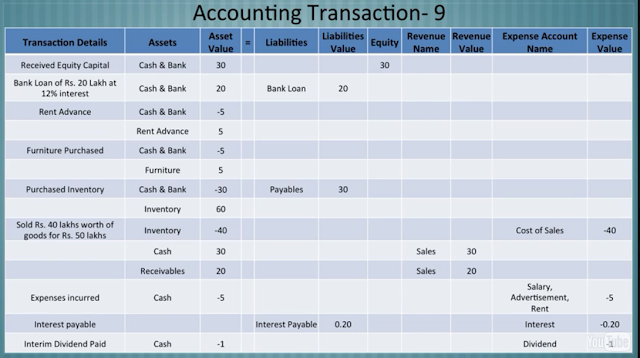
    Learn how simple Balance Sheet Preparation is, you will easily understand logic behind this with this Image presentation posted below:

    The Accounting Equation is a fundamental concept in accounting that represents the relationship between a company’s assets, liabilities, and equity. The equation is as follows:

    Assets = Liabilities + Equity

    The accounting equation must always be in balance, which means that the total assets of a company must equal the sum of its liabilities and equity. Every financial transaction affects the accounting equation, and it is important for accountants to understand how transactions affect each of the three components of the equation.

    Let’s look at a few examples of transactions and how they affect the accounting equation:

    1. A company receives $10,000 cash from a customer for services rendered. This transaction increases the company’s cash account (an asset) by $10,000. Since there is no corresponding increase in liabilities or equity, the accounting equation becomes:

    Assets = Liabilities + Equity $10,000 = 0 + $10,000

    1. The company purchases $5,000 worth of supplies on credit. This transaction increases the company’s supplies account (an asset) by $5,000, but it also increases the company’s accounts payable account (a liability) by $5,000 since the company has not yet paid for the supplies. The accounting equation becomes:

    Assets = Liabilities + Equity $15,000 = $5,000 + $10,000

    1. The company pays $1,000 in cash for rent. This transaction decreases the company’s cash account (an asset) by $1,000, but it also decreases the company’s retained earnings (a component of equity) by $1,000 since the company’s net income is reduced by the rent expense. The accounting equation becomes:

    Assets = Liabilities + Equity $14,000 = $5,000 + $9,000

    In summary, every transaction in accounting affects the accounting equation by changing the values of assets, liabilities, and equity. It is essential for accountants to keep track of these changes to ensure that the accounting equation remains in balance.

    This image has an empty alt attribute; its file name is Screenshot_10.png
    Transaction Image to learn Accounting Transaction in more detail: Image for educational purpose only just used for Balance Sheet preparation

    Pages: 1 2 3 4

  • Introduction – The Accounting Equation

    Introduction – The Accounting Equation

    From the large, multi-national corporation down to the corner beauty salon, every business transaction will have an effect on a company’s financial position. The financial position of a company is measured by the following items:

    1. Assets (what it owns)
    2. Liabilities (what it owes to others)
    3. Owner’s Equity (the difference between assets and liabilities)

    The accounting equation (or basic accounting equation) offers us a simple way to understand how these three amounts relate to each other. The accounting equation for a sole proprietorship is:

    14x-simple-table-01a

    The accounting equation for a corporation is:

    14x-simple-table-01b

    Assets are a company’s resources—things the company owns. Examples of assets include cash, accounts receivable, inventory, prepaid insurance, investments, land, buildings, equipment, and goodwill. From the accounting equation, we see that the amount of assets must equal the combined amount of liabilities plus owner’s (or stockholders’) equity.Liabilities are a company’s obligations—amounts the company owes. Examples of liabilities include notes or loans payable, accounts payable, salaries and wages payable, interest payable, and income taxes payable (if the company is a regular corporation). Liabilities can be viewed in two ways:(1) as claims by creditors against the company’s assets, and
    (2) a source—along with owner or stockholder equity—of the company’s assets.Owner’s equity or stockholders’ equity is the amount left over after liabilities are deducted from assets:Assets – Liabilities = Owner’s (or Stockholders’) Equity.Owner’s or stockholders’ equity also reports the amounts invested into the company by the owners plus the cumulative net income of the company that has not been withdrawn or distributed to the owners.If a company keeps accurate records, the accounting equation will always be “in balance,” meaning the left side should always equal the right side. The balance is maintained because every business transaction affects at least two of a company’s accounts. For example, when a company borrows money from a bank, the company’s assets will increase and its liabilities will increase by the same amount. When a company purchases inventory for cash, one asset will increase and one asset will decrease. Because there are two or more accounts affected by every transaction, the accounting system is referred to as double-entry accounting.A company keeps track of all of its transactions by recording them in accounts in the company’s general ledger.Each account in the general ledger is designated as to its type: asset, liability, owner’s equity, revenue, expense, gain, or loss account.We created a visual tutorial to demonstrate how a variety of transactions will affect the accounting equation and the financial statements. It is available in AccountingCoach PRO along with test questions that pertain to the accounting equation.

    Balance Sheet and Income Statement

    The balance sheet is also known as the statement of financial position and it reflects the accounting equation. The balance sheet reports a company’s assets, liabilities, and owner’s (or stockholders’) equity at a specific point in time. Like the accounting equation, it shows that a company’s total amount of assets equals the total amount of liabilities plus owner’s (or stockholders’) equity.The income statement is the financial statement that reports a company’s revenues and expenses and the resulting net income. While the balance sheet is concerned with one point in time, the income statement covers a time interval or period of time. The income statement will explain part of the change in the owner’s or stockholders’ equity during the time interval between two balance sheets.

    Introduction to the Accounting Equation  From the large, multi-national corporation down to the corner beauty salon, every business transaction will have an effect on a company's financial position. The financial position of a company is measured by the following items:      Assets (what it owns)     Liabilities (what it owes to others)     Owner's Equity (the difference between assets and liabilities)  The accounting equation (or basic accounting equation) offers us a simple way to understand how these three amounts relate to each other. The accounting equation for a sole proprietorship is: 14x-simple-table-01a  The accounting equation for a corporation is: 14x-simple-table-01b  Assets are a company's resources—things the company owns. Examples of assets include cash, accounts receivable, inventory, prepaid insurance, investments, land, buildings, equipment, and goodwill. From the accounting equation, we see that the amount of assets must equal the combined amount of liabilities plus owner's (or stockholders') equity.  Liabilities are a company's obligations—amounts the company owes. Examples of liabilities include notes or loans payable, accounts payable, salaries and wages payable, interest payable, and income taxes payable (if the company is a regular corporation). Liabilities can be viewed in two ways:  (1) as claims by creditors against the company's assets, and (2) a source—along with owner or stockholder equity—of the company's assets.  Owner's equity or stockholders' equity is the amount left over after liabilities are deducted from assets:      Assets - Liabilities = Owner's (or Stockholders') Equity.  Owner's or stockholders' equity also reports the amounts invested into the company by the owners plus the cumulative net income of the company that has not been withdrawn or distributed to the owners.  If a company keeps accurate records, the accounting equation will always be

    Thanks for Reading.

  • IFRS Standard & Interpretation Updates

    IFRS Standard & Interpretation Updates

    Financial statement considerations in adopting new and revised pronouncements

    Where new and revised pronouncements are applied for the first time, there can be consequential impacts on annual financial statements, including:

    • Updates to accounting policies. The terminology and substance of disclosed accounting policies may need to be updated to reflect new recognition, measurement and other requirements, e.g. IAS 19 Employee Benefits may impact the measurement of certain employee benefits.
    • Impact of transitional provisions. IAS 8 Accounting Policies, Changes in Accounting Estimates and Errors contains a general requirement that changes in accounting policies are retrospectively applied, but this does not apply to the extent an individual pronouncement has specific transitional provisions.
    • Disclosures about changes in accounting policies. Where an entity changes its accounting policy as a result of the initial application of an IFRS and it has an effect on the current period or any prior period, IAS 8 requires the disclosure of a number of matters, e.g. the title of the IFRS, the nature of the change in accounting policy, a description of the transitional provisions, and the amount of the adjustment for each financial statement line item affected
    • Third statement of financial position. IAS 1 Presentation of Financial Statements requires the presentation of a third statement of financial position as at the beginning of the preceding period in addition to the minimum comparative financial statements in a number of situations, including if an entity applies an accounting policy retrospectively and the retrospective application has a material effect on the information in the statement of financial position at the beginning of the preceding period
    • Earnings per share (EPS). Where applicable to the entity, IAS 33 Earnings Per Share requires basic and diluted EPS to be adjusted for the impacts of adjustments result from changes in accounting policies accounted for retrospectively and IAS 8requires the disclosure of the amount of any such adjustments.

    Whilst disclosures associated with changes in accounting policies resulting from the initial application of new and revised pronouncements are less in interim financial reports under IAS 34 Interim Financial Reporting, some disclosures are required, e.g. description of the nature and effect of any change in accounting policies and methods of computation.

    IFRS9 Financial Instruments (2014) {Effective for annual periods beginning on or after 1 January 2018}

    A finalised version of IFRS 9 which contains accounting requirements for financial instruments, replacing IAS39 Financial Instruments: Recognition and Measurement. The standard contains requirements in the following areas:

    ReadMore

    For more information, read our previous post: Brief Overview of IFRS & How it’s different from US GAAP – Singhvi Online

    Thanks for Reading.

  • Brief Overview of IFRS & How it’s different from US GAAP

    Brief Overview of IFRS & How it’s different from US GAAP

    “What’s the fuss over IFRS?” 

    Providing a brief overview of the transition to adoption of IFRS and convergence with US GAAP. While we realize that IFRS will become a future reality, the question lingered regarding the differences between the two accounting standards. I thought it would be useful to assess the areas of major differences. In this short blog post, it will not be impossible to address all the components of IFRS but we’ll try and capture primary differences.                   

    IFRS standards are broader and more principles-based than U.S. GAAP. This represents a hurdle for many U.S. CPA’s because we have been used to narrow “bright line” rules and guidelines on how to apply GAAP. IFRS tends to leave implementation of the principles up to preparation of financial statements and auditors. The regulatory and legal environment in the United States has been primarily responsible for narrower prescriptive interpretation of accounting rules. Adoption of IFRS will require a paradigm shift by accountants in the United States.

    Financial statement presentation represents an area where differences exist. For example International Accounting Standards does not provide a standard layout as prescribed by the SEC. One of the big differences is that IFRS requires debt associated with a covenant violation to be presented as a current liability unless there a lender agreement was reached prior to the balance sheet date. US GAAP allows the debt to be presented as non-current if an agreement was reached prior to issuing the financial statements. Another difference in financial statement presentation deals with income statement classification of expenses. The SEC requires presentation of expenses based on function whereas IFRS allows expenses to be presented by either function or nature of expenses. Additional differences exist with presentation of significant items. Variations emerge with disclosure of performance measures such as operating profit. IFRS does not define such items so there can be significant diversity in the items, headlines, and subtotals of the income statement between US GAAP and IFRS.

    A big area of divergence is with negative goodwill and research and development. IFRS requires that a reassessment of purchase price allocation be recognized as income while US GAAP allows negative goodwill to be allocated on a pro rata basis and can recognize the excess of the carrying amount of certain assets as an extraordinary gain. US GAAP requires research and development to be expensed immediately in contrast to IFRS which allows it to be capitalized as a finite-lived intangible asset. IFRS allows revaluation to the fair value of intangible assets other than goodwill whereas US GAAP does not permit revaluation.

    There are both similarities and differences in the treatment of inventory. US GAAP allows LIFO as an acceptable costing method in contrast to IFRS which prohibits the use of LIFO. There are also some differences in measurement of inventory value. US GAAP states that inventory should be carried at the lower of cost or market. Market is defined as current replacement cost as long as market does not exceed net realizable value. IFRS allows inventory to be carried at the lower of cost or net realizable value which is the best estimate of the amounts which inventories are expected to realize and may or may not be equal to fair value.

    While there are differences, the two standards boards are working to bring the two standards closer together. This should make the shift to IFRS easier when it comes time to change. One of the most significant areas where differences are being converged is revenue recognition. Currently US GAAP is more prescriptive than IFRS, especially for application to specific industry situations such as the sale of software and real estate. It will take time and effort to bring the two standards on to the same page. I looked at the two standards with the objective of understanding the key differences. The journey to convergence and adoption of IFRS will be interesting, challenging, and educational to say the least.

    The IFRS: History and Purpose

    The IFRS is designed as a common global language for business affairs so that company accounts are understandable and comparable across international boundaries. They are a consequence of growing international shareholding and trade. The IFRS is particularly important for companies that have dealings in several countries. They are progressively replacing the many different national accounting standards.

    The IFRS began as an attempt to harmonize accounting across the European Union, but the value of harmonization quickly made the concept attractive around the world. They are occasionally called by the original name of International Accounting Standards (IAS). The IAS were issued between 1973 and 2001 by the Board of the International Accounting Standards Committee (IASC). On April 1, 2001, the new IASB took over the responsibility for setting International Accounting Standards from the IASC. During its first meeting the new Board adopted existing IAS and Standing Interpretations Committee standards (SICs). The IASB has continued to develop standards calling the new standards the IFRS.

    Framework

    The Conceptual Framework for Financial Reporting states the basic principles for IFRS. The IASB and FASB frameworks are in the process of being updated and converged. The Joint Conceptual Framework project intends to update and refine the existing concepts to reflect the changes in markets and business practices. The project also intends consider the changes in the economic environment that have occurred in the two or more decades since the concepts were first developed.

    IFRS Defined Objective of Financial Statements

    A financial statement should reflect true and fair view of the business affairs of the organization. As these statements are used by various constituents of the society/regulators, they need to reflect an accurate view of the financial position of the organization. It is very helpful to check the financial position of the business for a specific period.

    Read More

    Learn more about US GAAP Click Here: Generally Accepted Accounting Principles – Rohitashva Singhvi

    Thanks for Reading.

  • Financial Accounting – Concepts

    Financial Accounting – Concepts

    Accounting Concepts :: Assumptions & Practices

    1. Business Entity Concept :

      In accounting, a business or an organization and its owners are treated as two separately identifiable parties. This is called the entity concept. The business stands apart from other organizations as a separate economic unit.

    2. Going Concern Concept :

      A going concern is a business that is assumed will meet its financial obligations when they fall due. It functions without the threat of liquidation for the foreseeable future, which is usually regarded as at least the next 12 months or the specified accounting period (the longer of the two). The presumption of going concern for the business implies the basic declaration of intention to keep operating its activities at least for the next year, which is a basic assumption for preparing financial statements that comprehend the conceptual framework of the IFRS. Hence, a declaration of going concern means that the business has neither the intention nor the need to liquidate or to materially curtail the scale of its operations.

    3. Accounting Period Concept :

      An accounting period, in bookkeeping, is the period with reference to which management accounts and financial statements are prepared. In management accounting the accounting period varies widely and is determined by management. Monthly accounting periods are common.

    4. Matching Concept :

      In accrual accounting, the matching principle instructs that an expense should be reported in the same period in which the corresponding revenue is earned, and is associated with accrual accounting and the revenue recognition principle states that revenues should be recorded during the period in which they are earned, regardless of when the transfer of cash occurs. By recognizing costs in the period they are incurred, a business can see how much money was spent to generate revenue, reducing “noise” from timing mismatch between when costs are incurred and when revenue is realized. Conversely, cash basis accounting calls for the recognition of an expense when the cash is paid, regardless of when the expense was actually incurred.

    5. Cost Concept :

      In accounting, the cost principle is part of the generally accepted accounting principles. Assets should always be recorded at their cost, when the asset is new and also for the life of the asset.

    6. Money Measurement Concept :

      The money measurement concept underlines the fact that in accounting and economics generally, every recorded event or transaction is measured in terms of money, the local currency monetary unit of measure.

    7. Dual Aspect Concept :

      Each transactions has two aspects > Receiving the Benefit or Giving the Benefit
      The dual aspect concept states that every business transaction requires recordation in two different accounts.
      Assets = Liabilities + Equity

    8. Revenue Recognition (realization) concept :

      The revenue recognition principle is a cornerstone of accrual accounting together with the matching principle. They both determine the accounting period in which revenues and expenses are recognized. (Ex. Services Rendered / Goods Delivered)

    9. Accrual Concept

      Accrual of something is, in finance, the adding together of interest or different investments over a period of time. It holds specific meanings in accounting, where it can refer to accounts on a balance sheet that represent liabilities and non-cash-based assets used in accrual-based accounting. (Ex. Events are recorded as they occur regardless when cash is paid/received)

    10. Materiality

      Materiality is a concept or convention within auditing and accounting relating to the importance/significance of an amount, transaction, or discrepancy.

    11. Consistency

      The concept of consistency means that accounting methods once adopted must be applied consistently in future. That means accounting practices and policies are consistent from one period to the other.

    12. Conservatism

      In accounting, the convention of conservatism, also known as the doctrine of prudence, is a policy of anticipating possible future losses but not future gains. This policy tends to understate rather than overstate net assets and net income, and therefore lead companies to “play safe”. When given a choice between several outcomes where the probabilities of occurrence are equally likely, you should recognize that transaction resulting in the lower amount of profit, or at least the deferral of a profit.

    13. Full Disclosure

      The full disclosure requires that all material facts must be disclosed in the financial statements. For example, in the case of sundry debtors, not only the total amount of sundry debtors should be disclosed, but also the amount of good and secured debtors, the amount of good but unsecured debtors and amount of doubtful debts should be stated. This does not mean disclosure of each and every item of information. It only means disclosure of such information which is of significance to owners, investors and creditors.

    Stay tuned for next blog, Be Well


  • What is Accounting & how it is classified?

    What is Accounting & how it is classified?

    Accounting is the systematic process of recording, summarizing, analyzing, and reporting financial transactions of a business or individual.

    It serves as the backbone of any financial system, providing a clear picture of an organization’s financial health and guiding decision-making.

    Through accounting, businesses can track income and expenses, ensure statutory compliance, and provide investors, management, and regulators with quantitative financial information.

    Meaning of Accounting

    The primary objectives of accounting include:

    • Recording Transactions: Maintaining a detailed record of all financial transactions in chronological order.
    • Financial Reporting: Preparing financial statements that depict the business’s financial status.
    • Decision Making: Providing data that helps in planning and decision-making for future growth.
    • Compliance: Ensuring adherence to laws and regulations.
    • Financial Control: Managing resources effectively to avoid overspending or financial shortfalls.

    The Role of Accounting in Business:

    Accounting not only records financial transactions but also plays a crucial role in budgeting, forecasting, and strategic planning. It allows businesses to evaluate their performance, understand cash flows, and make informed decisions to optimize profitability.

    For example, an organization can use accounting data to identify which products generate the most revenue and which areas are incurring higher expenses, thus enabling the company to adjust its strategy accordingly.Accounting is the systematic process of recording, summarizing, analyzing, and reporting financial transactions of a business or individual.

    It serves as the backbone of any financial system, providing a clear picture of an organization’s financial health and guiding decision-making. Through accounting, businesses can track income and expenses, ensure statutory compliance, and provide investors, management, and regulators with quantitative financial information.

    Below are the Branches of Accounting:

    1. Financial Accounting:
      Financial accounting is the field of accounting concerned with the summary, analysis and reporting of financial transactions related to a business.
      It includes the standards, conventions and rules that accountants follow in recording and summarizing and in the preparation of financial statements.
    2. Managerial Accounting
      In management accounting or managerial accounting, managers use accounting information in decision-making and to assist in the management and performance of their control functions.
    3. Cost Accounting
      Cost accounting is defined as “a systematic set of procedures for recording and reporting measurements of the cost of manufacturing goods and performing services in the aggregate and in detail.
    4. Auditing
      An audit is an “independent examination of financial information of any entity, whether profit oriented or not, irrespective of its size or legal form when such an examination is conducted with a view to express an opinion thereon.
    5. Tax Accounting
      For understanding tax accounting, you need to understand tax.
      Tax: A tax is a compulsory financial charge or some other type of levy imposed on a taxpayer (an individual or legal entity) by a governmental organization in order to fund government spending and various public expenditures (regional, local, or national).
      Tax accounting is the subsector of accounting that deals with the preparations of tax returns and tax payments.
    6. Fiduciary Accounting
      A fiduciary accounting (sometimes called a “court accounting”) is a comprehensive report of the activity within a trust, estate, guardianship or conservatorship during a specific period.
    7. Project Accounting
      Project accounting is a type of managerial accounting oriented toward the goals of project management and delivery.
    8. Forensic Accounting
      Forensic accounting, forensic accountancy or financial forensics is the specialty practice area of accounting that investigates whether firms engage in financial reporting misconduct. Forensic accountants apply a range of skills and methods to determine whether there has been financial reporting misconduct.
    9. Political Campaign Accounting
      Political campaign accounting is a specialty practice area of accounting that focuses on developing and implementing financial systems needed by political campaign organizations to conduct efficient campaign operations and to comply with complex financial reporting statutes. It differs from traditional management and financial consultancy in that it incorporates election law requirements and the unique requirements of political campaigns.
    10. Accounting Information System
      An accounting as an information system is a system of collecting, storing and processing financial and accounting data that are used by decision makers. An accounting information system is generally a computer-based method for tracking accounting activity in conjunction with information technology resources.

    thanks for reading, stay connected and blessed.


  • SFAS 78 With Summary

    SFAS 78 With Summary

    SUMMARY OF STATEMENT NO. 78
    CLASSIFICATION OF OBLIGATIONS THAT ARE CALLABLE BY THE CREDITOR—AN AMENDMENT OF ARB NO. 43, CHAPTER 3A (ISSUED 12/83)Summary
    This Statement amends ARB No. 43, Chapter 3A, “Current Assets and Current Liabilities,” to specify the balance sheet classification of obligations that, by their terms, are or will be due on demand within one year (or operating cycle, if longer) from the balance sheet date. It also specifies the classification of long-term obligations that are or will be callable by the creditor either because the debtor’s violation of a provision of the debt agreement at the balance sheet date makes the obligation callable or because the violation, if not cured within a specified grace period, will make the obligation callable. Such callable obligations are to be classified as current liabilities unless one of the following conditions is met:
    The creditor has waived or subsequently lost the right to demand repayment for more than one year (or operating cycle, if longer) from the balance sheet date.
    For long-term obligations containing a grace period within which the debtor may cure the violation, it is probable that the violation will be cured within that period, thus preventing the obligation from becoming callable.
    Short-term obligations expected to be refinanced on a long-term basis, including those callable obligations discussed herein, continue to be classified in accordance with FASB Statement No. 6, Classification of Short-Term Obligations Expected to Be Refinanced. This Statement is effective for financial statements for fiscal years beginning after December 15, 1983 and for interim periods within those fiscal years.

    Source: FASB

    Thanks for reading.

  • VAT(Identification of Designated Zones) – UAE

    VAT(Identification of Designated Zones) – UAE

    VAT treatment of Free Zones

    VAT is a general consumption tax imposed on most supplies of goods and services in the UAE. By default, it is chargeable on supplies of goods and services throughout the territorial area of the UAE. This territorial area will also include those areas currently defined as both fenced and non-fenced Free Zones. For VAT purposes, both fenced and unfenced Free Zones are considered to be within the territorial scope of the UAE – and therefore subject to the normal UAE VAT rules – unless they fulfil the criteria to be treated as a Designated Zone as defined by the Federal Decree-Law on VAT1 and Executive Regulations2. Those Free Zones which are Designated Zones are treated as being outside of the territory of the UAE for VAT purposes for specific supplies of goods. In addition, there are special VAT rules in respect of VAT treatment of certain supplies made within Designated Zones. The effect of these rules is that certain supplies of goods made within Designated Zones are not be subject to UAE VAT. In contrast, supplies of services made within Designated Zones are treated in the same way as supplies of services in the rest of the UAE. Important: Free Zones meeting the criteria have been specifically identified by way of a Cabinet Decision as Designated Zones. Where a Free Zone is not a Designated Zone, it is treated like any other part of the UAE.

    Identification of a Designated Zone A Designated Zone is an area specified by a Cabinet Decision as being a “Designated Zone” 3. Free Zones listed by the Cabinet Decision as being a Designated Zone can be found under the Legislation tab on the FTA website (www.tax.gov.ae). Although an area might be identified as a Designated Zone, it is not automatically treated as being outside the UAE for VAT purposes. There are several main criteria4

    which must be met in order for a Designated Zone to be treated as outside the UAE for VAT purposes. These are as follows: 1. The Designated Zone must be a specific fenced geographic area. 2. The Designated Zone must have security measures and Customs controls in place to monitor the entry and exit of individuals and movement of goods to and from the Designated Zone. 3. The Designated Zone must have internal procedures regarding the method of keeping, storing and processing of goods within the Designated Zone. 4. The operator of the Designated Zone must comply with the procedures set out by the FTA. This means that where a Designated Zone has areas that meet the above requirements, and areas that do not meet the requirements, it will be treated as being outside the UAE only to the extent that the requirements are met. In addition, should a Designated Zone change the manner of its operation or no longer meet any of the conditions imposed on it which led to it being specified as a Designated Zone by way of the Cabinet Decision, it shall be treated as though it is located within the territory of the UAE5. Important: Only where a Designated Zone meets all the above tests it can be treated as outside the UAE for VAT purposes.

    Entities within a Designated Zone Those businesses which are established, registered or which have a place of residence within the Designated Zone are deemed to have a place of residence in the UAE for VAT purposes6. The effect of this is that where a business is operating in a Designated Zone, it itself will be onshore for VAT purposes, even though some of its supplies of goods may be outside the scope of UAE VAT.

    VAT registration Any person carrying on a business activity in the UAE and making taxable supplies in excess of the mandatory VAT registration threshold (i.e. a taxable person) must apply to be registered for VAT purposes.

    Any other person that is making taxable supplies or incurring expenses (which are subject to VAT), in excess of the voluntary VAT registration threshold may apply to register for VAT purposes. Important: Designated Zone businesses are considered to be established ‘onshore’ in the UAE for VAT purposes. This means that they have the same obligations as non-Designated Zone businesses and have to register, report and account for VAT under the normal rules. It also means they can join a tax group (VAT group) provided they meet the required conditions.

      ————————————————————————————————————————-
    1 Federal Decree-Law No. (8) of 2017 on Value Added Tax, hereafter ‘the Law’. 2 Cabinet Decision No. (52) on the Executive Regulations of Federal Decree-Law No.(8) of 2017 on Value Added Tax, hereafter the ‘Executive Regulations’. 3 Article 1, Executive Regulations: any area specified by a decision of the Cabinet upon the recommendation of the Minister, as a Designated Zone for the purpose of the Decree-Law. 4 Article 51(1), Executive Regulation.

    Source: tax.gov.ae

10 morning habits Embark on Your Writing Journey: A Beginner’s Guide Positive life with positive people mustreadbooks Business Startup