Tag: principles

  • The Distinctions Between “Made in UAE” and “Manufactured in UAE”

    The Distinctions Between “Made in UAE” and “Manufactured in UAE”

    Advertisement:

    When it comes to products labeled as “made in UAE” or “manufactured in UAE,” the differences may seem minimal, but understanding the nuances can provide valuable insights into the origin and production processes. In this blog post, we’ll explore the subtle distinctions between these terms and shed light on their implications for consumers.

    Formal vs. Informal Connotations: At first glance, both phrases convey that a product underwent assembly and finishing in the United Arab Emirates, meeting the criteria for classification as a UAE-made good. However, “made in UAE” holds a more formal connotation and is often associated with the official “Made in UAE” mark, a government-issued certification scheme for locally manufactured products. This emblem signifies that the product underwent specific quality control checks and adheres to requirements regarding local content and value addition. On the other hand, “manufactured in UAE” is more informal and is generally used as a broad statement of origin.

    Emphasis on Production Process: The choice between these terms can subtly emphasize different aspects of the production process. “Manufactured in UAE” tends to highlight the actual production and assembly occurring within the UAE. Meanwhile, “made in UAE” encompasses these processes but also implies broader ownership and responsibility over the product’s creation within the country.

    Legality Considerations: In certain cases, legal considerations may influence the preference for one term over the other, depending on specific trade agreements or regulations. However, for most general consumer purposes, these terms are often used interchangeably.

    Conclusion: In conclusion, whether a product is labeled “made in UAE” or “manufactured in UAE,” both phrases essentially communicate the same message: the product was created and finished in the United Arab Emirates. The choice between the two depends on the context and the desired level of formality. Understanding these subtle differences can empower consumers to make more informed choices when navigating the world of UAE-made goods.

    We hope this clarification proves helpful. Should you have any further questions, feel free to reach out.

  • Economic Substance Requirements in the UAE: A Comprehensive Guide

    Economic Substance Requirements in the UAE: A Comprehensive Guide

    In the dynamic business landscape of the United Arab Emirates (UAE), understanding and complying with economic substance regulations is paramount for companies engaged in specific activities. Economic substance goes beyond a mere paper trail, requiring companies to establish a genuine and substantial commercial presence within the country. In this blog post, we will delve into the registration process, key considerations, and available resources to help you navigate the intricate framework of economic substance requirements in the UAE.

    Registration Process:

    Identifying Relevant Activities:

    The first crucial step is determining whether your company is involved in any of the “Relevant Activities” outlined by the UAE Ministry of Finance. These include, but are not limited to:

    • Banking
    • Insurance
    • Investment Management
    • Lease-financing
    • Headquarters
    • Shipping
    • Holding Company
    • Intellectual Property
    • Distribution and Service Centers

    Economic Substance Test:

    Companies engaged in relevant activities must undergo the “Economic Substance Test” to validate their substantial economic presence. The test comprises three key components:

    1. Directed and Managed in the UAE: Key decisions and management functions must originate from within the UAE.
    2. Core Income Generating Activities (CIGA) conducted in the UAE: The activities generating the core income must take place within the UAE.
    3. Adequate People, Premises, and Expenditure: The company should have sufficient personnel, office space, and resources in the UAE to support the activities.

    Notification and Reporting:

    All companies involved in relevant activities, irrespective of their economic substance test results, are required to submit an annual notification to the Federal Tax Authority (FTA). Companies failing the test must furnish a detailed Economic Substance Report outlining their circumstances and potential measures for compliance improvement.

    Types of Companies Subject to Registration:

    The economic substance regulations apply to:

    1. Onshore and Free Zone Companies: All UAE-registered companies engaged in relevant activities, whether onshore or in free zones.
    2. Branches of Foreign Companies: Foreign company branches operating in the UAE and conducting relevant activities must also adhere to these regulations.
    3. Representative Offices: Although representative offices typically do not generate income, they may need to register if involved in substantive activities related to relevant activities.

    Exemptions:

    Certain exemptions exist, such as companies with specific licenses or those solely managing their investments. However, it is advisable to consult with a qualified tax advisor to ascertain your unique situation and compliance requirements.

    Resources:

    To stay informed and ensure compliance, refer to the following resources:

    • Ministry of Finance Economic Substance Regulations: Link
    • Federal Tax Authority Economic Substance Guidelines: Link
    • PwC guide to UAE Economic Substance Regulations: Link

    Conclusion:

    Adhering to economic substance regulations is essential to avoid penalties and potential disruptions in your business operations within the UAE. For personalized advice and guidance tailored to your specific circumstances, consider seeking professional assistance from a tax advisor or financial expert. If you have any questions or require further clarification, feel free to reach out for expert support.

    Thanks for Reading.

  • UAE Corporate Tax – All in one basic info

    UAE Corporate Tax – All in one basic info

    What is Corporate Tax?

    Corporate Tax is a form of direct tax levied on the net income of corporations and other businesses.

    Corporate Tax is sometimes also referred to as “Corporate Income Tax” or “Business Profits Tax” in other jurisdictions.

    Who is subject to Corporate Tax?

    Broadly, Corporate Tax applies to the following “Taxable Persons”:

    • UAE companies and other juridical persons that are incorporated or effectively managed and controlled in the UAE;
    • Natural persons (individuals) who conduct a Business or Business Activity in the UAE as specified in a Cabinet Decision to be issued in due course; and
    • Non-resident juridical persons (foreign legal entities) that have a Permanent Establishment in the UAE (which is explained under [Section 8]).

    Juridical persons established in a UAE Free Zone are also within the scope of Corporate Tax as “Taxable Persons” and will need to comply with the requirements set out in the Corporate Tax Law. However, a Free Zone Person that meets the conditions to be considered a Qualifying Free Zone Person can benefit from a Corporate Tax rate of 0% on their Qualifying Income (the conditions are included in [Section 14]).

    Non-resident persons that do not have a Permanent Establishment in the UAE or that earn UAE sourced income that is not related to their Permanent Establishment may be subject to Withholding Tax (at the rate of 0%). Withholding tax is a form of Corporate Tax collected at source by the payer on behalf of the recipient of the income. Withholding taxes exist in many tax systems and typically apply to the cross-border payment of dividends, interest, royalties and other types of income.

    Who is exempt from Corporate Tax?

    Certain types of businesses or organisations are exempt from Corporate Tax given their importance and contribution to the social fabric and economy of the UAE. These are known as Exempt Persons and include:

    Automatically exempt●     Government Entities●     Government Controlled Entities that are specified in a Cabinet Decision
    Exempt if notified to the Ministry of Finance (and subject to meeting certain conditions)●     Extractive Businesses●     Non-Extractive Natural Resource Businesses
    Exempt if listed in a Cabinet Decision●     Qualifying Public Benefit Entities
    Exempt if applied to and approved by the Federal Tax Authority (and subject to meeting  certain conditions)●     Public or private pension and social security funds●     Qualifying Investment Funds●     Wholly-owned and controlled UAE subsidiaries of a Government Entity, a Government Controlled Entity, a Qualifying Investment Fund, or a public or private pension or social security fund

    In addition to not being subject to Corporate Tax, Government Entities, Government Controlled Entities that are specified in a Cabinet Decision, Extractive Businesses and Non-Extractive Natural Resource Businesses may also be exempted from any registration, filing and other compliance obligations imposed by the Corporate Tax Law, unless they engage in an activity which is within the charge of Corporate Tax.

    How is a Taxable Person subject to Corporate Tax?

    In line with the tax regimes of most countries, the Corporate Tax Law taxes income on both a residence and source basis. The applicable basis of taxation depends on the classification of the Taxable Person.

    • A “Resident Person” is taxed on income derived from both domestic and foreign sources (i.e. a residence basis).
    • A “Non-Resident Person” will be taxed only on income derived from sources within the UAE (i.e. a source basis).

    Residence for Corporate Tax purposes is not determined by where a person resides or is domiciled but instead by specific factors that are set out in the Corporate Tax Law.  If a Person does not satisfy the conditions for being either a Resident or a Non-Resident person then they will not be a Taxable Person and will not therefore be subject to Corporate Tax.

    Who is a Resident Person?

    Companies and other juridical persons that are incorporated or otherwise formed or recognised under the laws of the UAE will automatically be considered a Resident Person for Corporate Tax purposes. This covers juridical persons incorporated in the UAE under either mainland legislation or applicable Free Zone regulations, and would also include juridical persons created by a specific statute (e.g. by a special decree).

    Foreign companies and other juridical persons may also be treated as Resident Persons for Corporate Tax purposes where they are effectively managed and controlled in the UAE. This shall be determined with regard to the specific circumstances of the entity and its activities, with a determining factor being where key management and commercial decisions are in substance made.

    Natural persons will be subject to Corporate Tax as a “Resident Person” on income from both domestic and foreign sources, but only insofar as such income is derived from a Business or Business Activity conducted by the natural person in the UAE. Any other income earned by a natural person would not be within the scope of Corporate Tax.

    Who is a Non-Resident Person?

    Non-Resident Persons are juridical persons who are not Resident Persons and:

    • have a Permanent Establishment in the UAE; or
    • derive State Sourced Income.

    Non-Resident Persons will be subject to Corporate Tax on Taxable Income that is attributable to their Permanent Establishment (which is explained under Section 8).

    Certain UAE sourced income of a Non-Resident Person that is not attributable to a Permanent Establishment in the UAE will be subject to Withholding Tax at the rate of 0%.

    What is a Permanent Establishment?

    The concept of Permanent Establishment is an important principle of international tax law used in corporate tax regimes across the world. The main purpose of the Permanent Establishment concept in the UAE Corporate Tax Law is to determine if and when a foreign person has established sufficient presence in the UAE to warrant the business profits of that foreign person to be subject to Corporate Tax.

    The definition of Permanent Establishment in the Corporate Tax Law has been designed on the basis of the definition provided in Article 5 of the OECD Model Tax Convention on Income and Capital and the position adopted by the UAE under the Multilateral Instrument to Implement Tax Treaty Related Measures to Prevent Base Erosion and Profit Shifting. This allows foreign persons to use the relevant Commentary of Article 5 of the OECD Model Tax Convention when assessing whether they have a Permanent Establishment or not in the UAE. This assessment should consider the provisions of any bilateral tax agreement between the country of residence of the Non-Resident Person and the UAE. 

    What is Corporate Tax imposed on?

    Corporate Tax is imposed on Taxable Income earned by a Taxable Person in a Tax Period.

    Corporate Tax would generally be imposed annually, with the Corporate Tax liability calculated by the Taxable Person on a self-assessment basis. This means that the calculation and payment of Corporate Tax is done through the filing of a Corporate Tax Return with the Federal Tax Authority by the Taxable Person.

    The starting point for calculating Taxable Income is the Taxable Person’s accounting income (i.e. net profit or loss before tax) as per their financial statements. The Taxable Person will then need to make certain adjustments to determine their Taxable Income for the relevant Tax Period. For example, adjustments to accounting income may need to be made for income that is exempt from Corporate Tax and for expenditure that is wholly or partially non-deductible for Corporate Tax purposes.

    What income is exempt?

    The Corporate Tax Law also exempts certain types of income from Corporate Tax. This means that a Taxable Persons will not be subject to Corporate Tax on such income and cannot claim a deduction for any related expenditure. Taxable Persons who earn exempt income will remain subject to Corporate Tax on their Taxable Income.

    The main purpose of certain income being exempt from Corporate Tax is to prevent double taxation on certain types of income. Specifically, dividends and capital gains earned from domestic and foreign shareholdings will generally be exempt from Corporate Tax. Furthermore, a Resident Person can elect, subject to certain conditions, to not take into account income from a foreign Permanent Establishment for UAE Corporate Tax purposes.

    What expenses are deductible?

    In principle, all legitimate business expenses incurred wholly and exclusively for the purposes of deriving Taxable Income will be deductible, although the timing of the deduction may vary for different types of expenses and the accounting method applied. For capital assets, expenditure would generally be recognised by way of depreciation or amortisation deductions over the economic life of the asset or benefit.

    Expenditure that has a dual purpose, such as expenses incurred for both personal and business purposes, will need to be apportioned with the relevant portion of the expenditure treated as deductible if incurred wholly and exclusively for the purpose of the taxable person’s business.

    Certain expenses which are deductible under general accounting rules may not be fully deductible for Corporate Tax purposes. These will need to be added back to the Accounting Income for the purposes of determining the Taxable Income. Examples of expenditure that is or may not be deductible (partially or in full) include:

    Types of ExpendituresLimitation to deductibility
    BribesFines and penalties (other than amounts awarded as compensation for damages or breach of contract)Donations, grants or gifts made to an entity that is not a Qualifying Public Benefit EntityDividends and other profits distributionsCorporate Tax imposed under the Corporate Tax LawExpenditure not incurred wholly and exclusively for the purposes of the Taxable person’s BusinessExpenditure incurred in deriving income that is exempt from Corporate TaxNo deduction
    Client entertainment expenditurePartial deduction of 50% of the amount of the expenditure
    Interest expenditureDeduction of net interest expenditure exceeding a certain de minimis thresholdup to 30% of the amount of earnings before the deduction of interest, tax, depreciation and amortisation (except for certain activities)

    What is the Corporate Tax rate?

    Corporate Tax will be levied at a headline rate of 9% on Taxable Income exceeding AED 375,000. Taxable Income below this threshold will be subject to a 0% rate of Corporate Tax.

    Corporate Tax will be charged on Taxable Income as follows:

    Resident Taxable Persons
    Taxable Income not exceeding AED 375,000(this amount is to be confirmed in a Cabinet Decision)0%
    Taxable Income exceeding AED 375,0009%
    Qualifying Free Zone Persons
    Qualifying Income0%
    Taxable Income that does not meet the Qualifying Income definition9%

    What is the Withholding Tax rate?

    A 0% withholding tax may apply to certain types of UAE sourced income paid to non-residents. Because of the 0% rate, in practice, no withholding tax would be due and there will be no withholding tax related registration and filing obligations for UAE businesses or foreign recipients of UAE sourced income.

    Withholding tax does not apply to transactions between UAE resident persons.

    When can a Free Zone Person be a Qualifying Free Zone Person?

    A Free Zone Person that is a Qualifying Free Zone Person can benefit from a preferential Corporate Tax rate of 0% on their “Qualifying Income” only.

    In order to be considered a Qualifying Free Zone Person, the Free Zone Person must:

    • maintain adequate substance in the UAE;
    • derive ‘Qualifying Income’;
    • not have made an election to be subject to Corporate Tax at the standard rates; and
    • comply with the transfer pricing requirements under the Corporate Tax Law.

    The Minister may prescribe additional conditions that a Qualifying Free Zone Person must meet.

    If a Qualifying Free Zone Person fails to meet any of the conditions, or makes an election to be subject to the regular Corporate Tax regime, they will be subject to the standard rates of Corporate Tax from the beginning of the Tax Period where they failed to meet the conditions.

    What are Tax Groups, and when can they be formed?

    Two or more Taxable Persons who meet certain conditions (see below) can apply to form a “Tax Group” and be treated as a single Taxable Person for Corporate Tax purposes.

    To form a Tax Group, both the parent company and its subsidiaries must be resident juridical persons, have the same Financial Year and prepare their financial statements using the same accounting standards.

    Additionally, to form a Tax Group, the parent company must:

    • own at least 95% of the share capital of the subsidiary;
    • hold at least 95% of the voting rights in the subsidiary; and
    • is entitled to at least 95% of the subsidiary’s profits and net assets.

    The ownership, rights and entitlement can be held either directly or indirectly through subsidiaries, but a Tax Group cannot include an Exempt Person or Qualifying Free Zone Person.

    How to calculate the Taxable Income of a Tax Group?

    To determine the Taxable Income of a Tax Group, the parent company must prepare consolidated financial accounts covering each subsidiary that is a member of the Tax Group for the relevant Tax Period. Transactions between the parent company and each group member and transactions between the group members would be eliminated for the purposes of calculating the Taxable Income of the Tax Group. 

    Registering, filing and paying Corporate Tax

    All Taxable Persons (including Free Zone Persons) will be required to register for Corporate Tax and obtain a Corporate Tax Registration Number. The Federal Tax Authority may also request certain Exempt Persons to register for Corporate Tax.

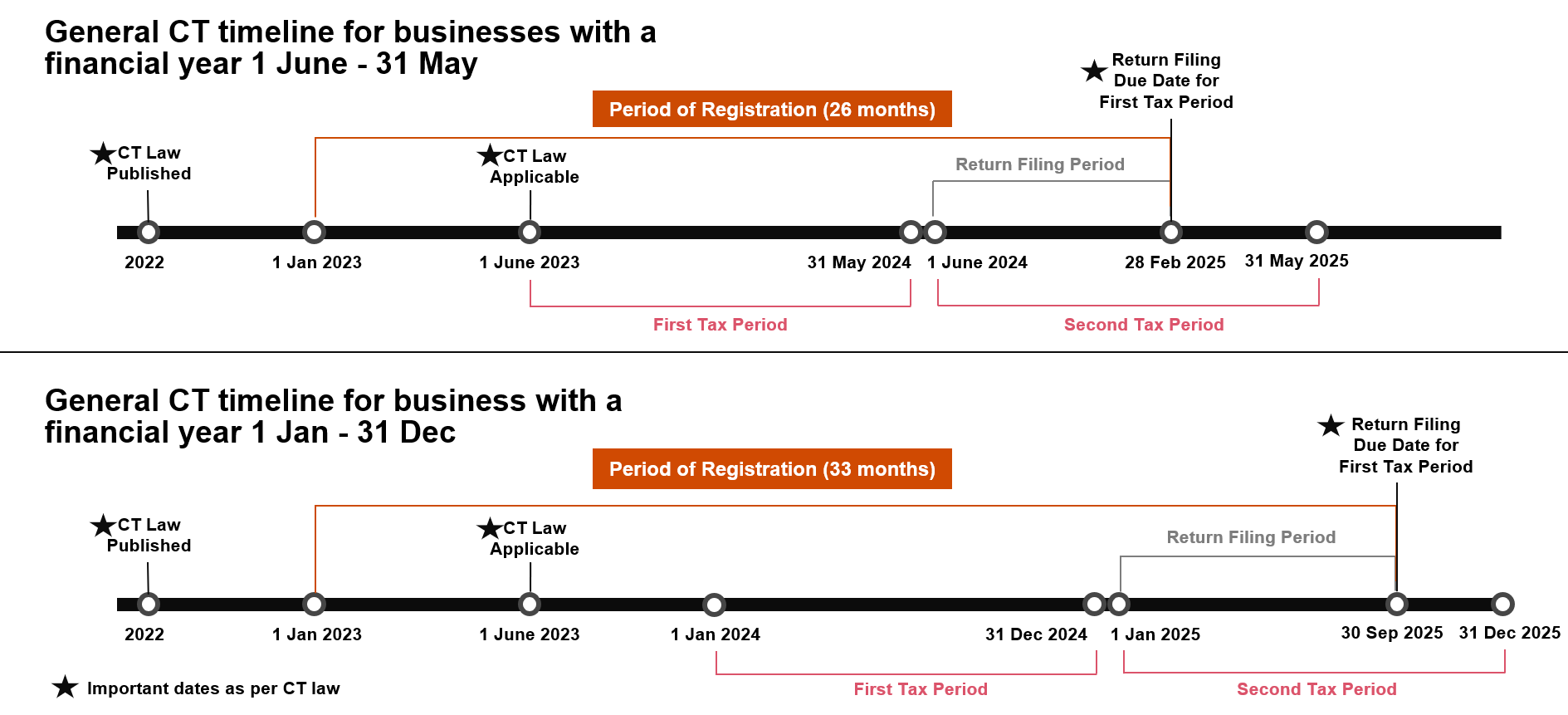
    Taxable Persons are required to file a Corporate Tax return for each Tax Period within 9 months from the end of the relevant period. The same deadline would generally apply for the payment of any Corporate Tax due in respect of the Tax Period for which a return is filed.

    Illustrated below are examples of the registration, filing and payment deadlines associated for Taxable Persons with a Tax Period (Financial Year) ending on 31 May or 31 December (respectively).

    filing and payment deadlines associated for Taxable Persons with a Tax Period (Financial Year) ending on 31 May or 31 December (respectively).

    How to prepare for Corporate Tax?

    1. Read the Corporate Tax Law and the supporting information available on the websites of the Ministry of Finance and the Federal Tax Authority.
    2. Use the available information to determine whether your business will be subject to Corporate Tax and if so, from what date.
    3. Understand the requirements for your business under the Corporate Tax Law, including, for example:
      1. Whether and by when your business needs to register for Corporate Tax;
      2. What is the accounting / Tax Period for your business;
      3. By when your business would need to file a Corporate Tax return;
      4. What elections or applications your business may or should make for Corporate Tax purposes;
      5. What financial information and records your business will need to keep for Corporate Tax purposes;
    4. Regularly check the websites of the Ministry of Finance and the Federal Tax Authority for further information and guidance on the Corporate Tax regime.

    Sources: FTA

    RSS Error: https://wealthcreatorhub.in/feed/ is invalid XML, likely due to invalid characters. XML error: Reserved XML Name at line 2, column 39
    Our Websites by Rohitashva Singhvi
  • Brief Summary of Bhagwat Geeta Teachings by Lord Krishna

    Brief Summary of Bhagwat Geeta Teachings by Lord Krishna

    The Bhagavad Gita is a sacred Hindu scripture that is considered one of the most important texts in the world. It is a dialogue between Lord Krishna and Arjuna, which takes place on the battlefield of Kurukshetra, just before the start of the great war of Mahabharata. The Gita consists of 18 chapters and is written in Sanskrit. Below is a brief summary of the teachings of the Bhagavad Gita.

    Chapter 1: Arjuna’s Dilemma

    Arjuna, a skilled warrior, finds himself in a dilemma on the battlefield. He is faced with the prospect of fighting and killing his own relatives and loved ones. Lord Krishna advises him to fulfill his duty as a warrior and fight for what is right.

    Chapter 2: The Yoga of Knowledge

    Krishna explains the concept of the Atman (the individual soul) and the Brahman (the universal soul). He stresses the importance of self-realization and detachment from material desires. He also teaches the importance of performing one’s duty without being attached to the fruits of one’s actions.

    Chapter 3: The Yoga of Action

    Krishna explains the importance of performing one’s duty in life without being attached to the results. He also discusses the concept of karma and how it affects one’s life.

    Chapter 4: The Yoga of Wisdom

    Krishna explains how knowledge and wisdom can lead one to liberation. He also discusses the concept of the avatar (divine incarnation) and how it relates to the world.

    Chapter 5: The Yoga of Renunciation

    Krishna discusses the concept of renunciation and how it relates to spiritual growth. He stresses the importance of self-discipline and control of the senses.

    Chapter 6: The Yoga of Meditation

    Krishna explains the practice of meditation and how it can lead to spiritual growth. He also discusses the concept of the Self and how it relates to the individual.

    Chapter 7: The Yoga of Knowledge and Wisdom

    Krishna explains the difference between knowledge and wisdom and how they relate to spiritual growth. He also discusses the concept of the divine and how it is present in all things.

    Chapter 8: The Yoga of Imperishable Brahman

    Krishna discusses the concept of Brahman and how it relates to the individual soul. He also explains the importance of devotion and surrender to the divine.

    Chapter 9: The Yoga of Sovereign Knowledge and Secret

    Krishna explains the concept of the ultimate reality and how it relates to the individual soul. He also discusses the importance of devotion to the divine.

    Chapter 10: The Yoga of Divine Manifestations

    Krishna discusses the various manifestations of the divine and how they relate to the individual soul. He also stresses the importance of devotion to the divine.

    Chapter 11: The Yoga of the Vision of the Cosmic Form

    Krishna shows Arjuna his cosmic form, revealing the true nature of the divine. Arjuna is overwhelmed by the experience and gains a deeper understanding of the nature of reality.

    Chapter 12: The Yoga of Devotion

    Krishna stresses the importance of devotion to the divine and explains how it can lead to spiritual growth. He also discusses the importance of detachment and self-control.

    Chapter 13: The Yoga of Discrimination

    Krishna discusses the concept of discrimination and how it relates to spiritual growth. He stresses the importance of understanding the difference between the body and the soul.

    Chapter 14: The Yoga of the Three Qualities

    Krishna explains the three gunas (qualities) and how they relate to the individual soul. He also discusses the importance of transcending the gunas and attaining liberation.

    Chapter 15: The Yoga of the Supreme Self

    Krishna explains the concept of the supreme self and how it relates to the individual soul. He also discusses the importance of understanding the nature of the divine and the true nature of reality.

    Chapter 16: The Yoga of the Division between the Divine and the Demoniacal

    Krishna discusses the difference between divine and demoniacal qualities and how they relate to the individual soul. He stresses the importance of cultivating divine qualities and transcending demoniacal qualities.

    Chapter 17: The Yoga of the Threefold Faith

    Krishna discusses the three types of faith – sattvic, rajasic, and tamasic – and how they relate to spiritual growth. He also discusses the importance of performing one’s duty without being attached to the results.

    Chapter 18: The Yoga of Liberation through Renunciation

    Krishna summarizes the teachings of the Bhagavad Gita and stresses the importance of performing one’s duty without being attached to the results. He also discusses the concept of renunciation and how it can lead to liberation.

    In summary, the Bhagavad Gita teaches the importance of performing one’s duty without being attached to the results, the importance of self-realization and detachment from material desires, and the importance of devotion to the divine. It also discusses the concepts of karma, the Atman, Brahman, and the nature of reality. The Gita provides a guide for spiritual growth and enlightenment, and its teachings continue to inspire and guide people around the world.

    Image Credit: Google Images

  • Accounts Payable Vs Accounts Receivable

    Accounts Payable Vs Accounts Receivable

    AP and AR are both important accounting terms used to manage a company’s finances.

    AP stands for Accounts Payable, which refers to the amount of money that a company owes to its vendors, suppliers, or other creditors for goods and services that have been received but not yet paid for. Essentially, it’s the amount that a company owes to others.

    AR stands for Accounts Receivable, which refers to the amount of money that a company is owed by its customers for goods and services that have been sold but not yet paid for. Essentially, it’s the amount that others owe to the company.

    Accounts Payable (AP) is a term used in accounting to refer to the amount of money that a company owes to its vendors or suppliers for goods or services that have been purchased but not yet paid for. AP is considered a liability on the company’s balance sheet.

    When a company purchases goods or services on credit, it creates an accounts payable entry in its books. This entry records the amount owed to the vendor, the invoice date, the due date, and other details. Once the company pays the vendor, it records a corresponding entry in its books to reduce the AP balance and reflect the payment.

    Managing AP involves processing invoices, reconciling statements, and making payments to vendors in a timely manner. Companies often have AP departments or personnel responsible for these tasks. Efficient AP management is important for maintaining good relationships with vendors and for ensuring that the company’s financial records are accurate and up-to-date.

    Accounts Receivable (AR) refers to the money that a company is owed by its customers for goods or services that have been delivered or rendered but not yet paid for. It is an asset on the balance sheet of a company, representing the amount of money that is expected to be received in the future from its customers.

    When a company sells its products or services on credit, it creates an account for each customer to whom it extends credit. The account is then recorded as an account receivable, indicating the amount owed by the customer to the company. The company keeps track of these accounts, and once the customer pays, the company records the transaction as a reduction in the accounts receivable balance and an increase in cash or another payment method.

    Accounts Receivable are important for a company’s cash flow management, as they represent a significant portion of its current assets. Efficient management of accounts receivable is necessary to ensure that a company has enough cash to cover its operational expenses and to invest in its growth.

    In other words, Accounts Payable is the money that a company needs to pay, and Accounts Receivable is the money that a company expects to receive. Managing both AP and AR effectively are crucial for a company’s financial health and cash flow management.

    The AP (Accounts Payable) and AR (Accounts Receivable) processes are important financial processes in any organization. Here is a high-level overview of the typical flow of each process:

    Accounts Payable (AP) Process Flow:

    1. Purchase Request: The process begins with a purchase request from a department within the organization.
    2. Purchase Order: The purchase request is reviewed and approved by the procurement department, which then issues a purchase order to the vendor.
    3. Invoice Receipt: Once the goods or services are received, the vendor issues an invoice to the organization.
    4. Invoice Verification: The invoice is verified against the purchase order and goods receipt to ensure accuracy.
    5. Approval: The invoice is then approved for payment by the appropriate department or individual within the organization.
    6. Payment: Payment is then made to the vendor according to the payment terms outlined in the contract.
    7. Recording: Finally, the payment is recorded in the organization’s accounting system.

    Accounts Receivable (AR) Process Flow:

    1. Sales Order: The process begins with a sales order from a customer.
    2. Invoice Creation: An invoice is created based on the sales order and sent to the customer.
    3. Invoice Delivery: The invoice is delivered to the customer through various channels such as email or mail.
    4. Payment Receipt: The customer pays the invoice either through check, credit card or other payment options.
    5. Payment Verification: The payment received is verified against the invoice.
    6. Payment Recording: The payment is recorded in the organization’s accounting system.
    7. Follow-up: If payment is not received, follow-up is done with the customer to collect the payment.

    Note that these are high-level overviews, and the details of the AP and AR processes can vary depending on the organization and the industry.

    For Accounts Payable Interview Questions please check out below:

    Accounts Payable Interview Q & A Session – Rohitashva Singhvi

    For Accounts Receivable Interview Questions please check out below:

    Accounts Receivable Interview Q & A Session – Rohitashva Singhvi


  • How to learn and understand about stock market step by step

    How to learn and understand about stock market step by step

    Learning about the stock market can seem overwhelming, but with the right approach, it can be a rewarding and fulfilling experience. Here are some steps you can follow to learn about the stock market:

    1. Start with the basics: Learn the fundamental concepts of the stock market such as stocks, bonds, mutual funds, exchange-traded funds (ETFs), and other investment products. This will help you understand the key terms and concepts used in the stock market.
    2. Read books and articles: There are many books and articles available that can help you learn about the stock market. Some good starting points include “The Intelligent Investor” by Benjamin Graham, “A Random Walk Down Wall Street” by Burton Malkiel, and “The Little Book of Common Sense Investing” by John C. Bogle.
    3. Take an online course: There are many online courses available that can help you learn about the stock market. Some popular platforms include Coursera, Udemy, and edX. These courses are often taught by experts in the field and can provide a structured learning experience.
    4. Follow financial news: Follow financial news sources such as Bloomberg, CNBC, and the Wall Street Journal to stay up-to-date with the latest developments in the stock market. This will help you understand the factors that drive the stock market and the impact of current events on stocks.
    5. Practice with virtual trading: Many online platforms offer virtual trading, which allows you to practice trading stocks without risking real money. This can be a great way to gain practical experience and test out different strategies.
    6. Attend seminars and workshops: Many financial institutions, brokerages, and trading firms offer seminars and workshops on the stock market. Attending these events can help you learn from experts and network with other traders.
    7. Consult with a financial advisor: If you have specific questions or concerns about the stock market, consult with a financial advisor who is well-versed in stock market investing. They can provide personalized advice and help you make informed investment decisions.

    In summary, learning about the stock market requires a combination of reading, research, and practical experience. By following these steps, you can gain a solid understanding of the stock market and become a confident investor.

    Pages: 1 2 3 4 5 6 7 8

  • How to determine product costing for manufacturing company

    How to determine product costing for manufacturing company

    Cost Components: Credit Google

    Product costing is a crucial aspect of managing a manufacturing concern, as it allows businesses to determine the total cost of producing a product. Knowing the total cost of production is important because it helps in setting a selling price that ensures profitability. In this blog, we will discuss how to do product costing for a manufacturing concern.

    Step 1: Determine the direct material cost:
    Direct material cost is the cost of raw materials that are used to produce a product. To determine the direct material cost, you need to identify the raw materials used in production and their cost per unit. Once you have identified the raw materials used, multiply the quantity of each material used by their respective cost per unit.
    Direct material cost = Cost per unit of raw material X Quantity of raw material used

    Material Cost: Credit Google

    Pages: 1 2 3 4 5

  • Basics of General Accounting

    Basics of General Accounting

    Accounting is the process of recording, classifying, summarizing, and interpreting financial information. It is essential for businesses to keep track of their financial transactions and make informed decisions. The primary purpose of accounting is to provide financial information that is useful in making economic decisions.

    Key Concepts

    1. Double-Entry System: Each transaction affects at least two accounts. The total debits must equal total credits.
    2. Accounting Equation: Assets = Liabilities + Equity. This fundamental equation must always be in balance.
    3. Financial Statements: The main financial statements are the Balance Sheet, Income Statement, Statement of Retained Earnings, and Cash Flow Statement.
    4. Accrual Accounting: Transactions are recorded when they are incurred, not necessarily when cash changes hands.
    5. GAAP and IFRS: Generally Accepted Accounting Principles (GAAP) and International Financial Reporting Standards (IFRS) are the frameworks and guidelines for accounting.

    Basic Journal Entries

    Journal entries are the building blocks of accounting, recording the business transactions in the books.

    Components of a Journal Entry

    1. Date: When the transaction occurred.
    2. Accounts: The accounts affected by the transaction.
    3. Debit and Credit: Amounts to be debited and credited.
    4. Description: A brief explanation of the transaction.

    Common Journal Entries

    1. Initial Investment by Owners
      • Debit: CashCredit: Owner’s Capital
      Date Account Debit Credit ------------------------------------------------ YYYY-MM-DD Cash XXXX Owner's Capital XXXX
    2. Purchase of Equipment for Cash
      • Debit: EquipmentCredit: Cash
      Date Account Debit Credit ------------------------------------------------ YYYY-MM-DD Equipment XXXX Cash XXXX
    3. Purchase of Inventory on Credit
      • Debit: InventoryCredit: Accounts Payable
      Date Account Debit Credit ------------------------------------------------ YYYY-MM-DD Inventory XXXX Accounts Payable XXXX
    4. Sales on Credit
      • Debit: Accounts ReceivableCredit: Sales Revenue
      Date Account Debit Credit ------------------------------------------------ YYYY-MM-DD Accounts Receivable XXXX Sales Revenue XXXX
    5. Payment of Expenses (e.g., Rent)
      • Debit: Rent ExpenseCredit: Cash
      Date Account Debit Credit ------------------------------------------------ YYYY-MM-DD Rent Expense XXXX Cash XXXX

    Advanced Journal Entries

    As transactions become more complex, so do the journal entries.

    1. Depreciation of Equipment
      • Debit: Depreciation ExpenseCredit: Accumulated Depreciation
      Date Account Debit Credit ---------------------------------------------------- YYYY-MM-DD Depreciation Expense XXXX Accumulated Depreciation XXXX
    2. Accrued Salaries (Salaries earned but not yet paid)
      • Debit: Salaries ExpenseCredit: Salaries Payable
      Date Account Debit Credit ---------------------------------------------------- YYYY-MM-DD Salaries Expense XXXX Salaries Payable XXXX
    3. Prepaid Expenses (e.g., Prepaid Insurance)
      • Initial Payment:
        • Debit: Prepaid InsuranceCredit: Cash
        Date Account Debit Credit ---------------------------------------------------- YYYY-MM-DD Prepaid Insurance XXXX Cash XXXX
      • At month-end adjustment:
        • Debit: Insurance ExpenseCredit: Prepaid Insurance
        Date Account Debit Credit ---------------------------------------------------- YYYY-MM-DD Insurance Expense XXXX Prepaid Insurance XXXX
    4. Unearned Revenue (e.g., advance payment received for services to be provided later)
      • When cash is received:
        • Debit: CashCredit: Unearned Revenue
        Date Account Debit Credit ---------------------------------------------------- YYYY-MM-DD Cash XXXX Unearned Revenue XXXX
      • When revenue is earned:
        • Debit: Unearned RevenueCredit: Service Revenue
        Date Account Debit Credit ---------------------------------------------------- YYYY-MM-DD Unearned Revenue XXXX Service Revenue XXXX
    5. Adjusting Entries for Bad Debts (Allowance Method)
      • Estimate of bad debts:
        • Debit: Bad Debt ExpenseCredit: Allowance for Doubtful Accounts
        Date Account Debit Credit ---------------------------------------------------- YYYY-MM-DD Bad Debt Expense XXXX Allowance for Doubtful Accounts XXXX
      • Write-off of specific accounts:
        • Debit: Allowance for Doubtful AccountsCredit: Accounts Receivable
        Date Account Debit Credit ---------------------------------------------------- YYYY-MM-DD Allowance for Doubtful Accounts XXXX
        Accounts Receivable XXXX

    Journal Entries for Provisions

    1. Provision for Bad Debts

    When estimating the provision:

    • Debit: Bad Debt Expense
    • Credit: Allowance for Doubtful Accounts

    Date Account Debit Credit
    -----------------------------------------------------------
    YYYY-MM-DD Bad Debt Expense XXXX
    Allowance for Doubtful Accounts XXXX

    When writing off specific bad debts:

    • Debit: Allowance for Doubtful Accounts
    • Credit: Accounts Receivable

    Date Account Debit Credit
    -----------------------------------------------------------
    YYYY-MM-DD Allowance for Doubtful Accounts XXXX
    Accounts Receivable XXXX

    2. Provision for Warranties

    When creating the provision:

    • Debit: Warranty Expense
    • Credit: Provision for Warranties

    Date Account Debit Credit
    -----------------------------------------------------------
    YYYY-MM-DD Warranty Expense XXXX
    Provision for Warranties XXXX

    When actual warranty claims are made:

    • Debit: Provision for Warranties
    • Credit: Cash/Inventory (depending on how the warranty is settled)

    Date Account Debit Credit
    -----------------------------------------------------------
    YYYY-MM-DD Provision for Warranties XXXX
    Cash/Inventory XXXX

    3. Provision for Legal Claims

    When estimating the provision:

    • Debit: Legal Expense
    • Credit: Provision for Legal Claims

    Date Account Debit Credit
    -----------------------------------------------------------
    YYYY-MM-DD Legal Expense XXXX
    Provision for Legal Claims XXXX

    When the legal claim is settled:

    • Debit: Provision for Legal Claims
    • Credit: Cash

    Date Account Debit Credit
    -----------------------------------------------------------
    YYYY-MM-DD Provision for Legal Claims XXXX
    Cash XXXX

    Example Scenario

    Let’s consider an example where a company estimates a $5,000 warranty provision at year-end and incurs actual warranty costs of $2,000 the following year.

    1. Creating the provision at year-end:

    Date Account Debit Credit
    -----------------------------------------------------------
    YYYY-12-31 Warranty Expense 5,000
    Provision for Warranties 5,000

    1. Settling warranty claims the following year:

    Date Account Debit Credit
    -----------------------------------------------------------
    YYYY-MM-DD Provision for Warranties 2,000
    Cash 2,000

    Provision Item Categories

    Provisions are set aside for specific liabilities of uncertain timing or amount. They are recorded on both the income statement (as expenses) and the balance sheet (as liabilities). Understanding the categorization of provision items helps ensure accurate financial reporting.

    Categories of Provisions

    1. Provision for Bad Debts (Allowance for Doubtful Accounts)
    2. Provision for Warranties
    3. Provision for Legal Claims
    4. Provision for Restructuring
    5. Provision for Environmental Liabilities
    6. Provision for Pension Liabilities

    Journal Entries for Provision Items

    1. Provision for Bad Debts

    Income Statement (Expense):

    • Bad Debt Expense

    Balance Sheet (Liability):

    • Allowance for Doubtful Accounts

    Initial Entry:

    Date Account Debit Credit
    -----------------------------------------------------------
    YYYY-MM-DD Bad Debt Expense XXXX
    Allowance for Doubtful Accounts XXXX

    Write-off Specific Bad Debts:

    Date Account Debit Credit
    -----------------------------------------------------------
    YYYY-MM-DD Allowance for Doubtful Accounts XXXX
    Accounts Receivable XXXX

    2. Provision for Warranties

    Income Statement (Expense):

    • Warranty Expense

    Balance Sheet (Liability):

    • Provision for Warranties

    Initial Entry:

    Date Account Debit Credit
    -----------------------------------------------------------
    YYYY-MM-DD Warranty Expense XXXX
    Provision for Warranties XXXX

    Actual Warranty Claim Settlement:

    Date Account Debit Credit
    -----------------------------------------------------------
    YYYY-MM-DD Provision for Warranties XXXX
    Cash/Inventory XXXX

    3. Provision for Legal Claims

    Income Statement (Expense):

    • Legal Expense

    Balance Sheet (Liability):

    • Provision for Legal Claims

    Initial Entry:

    Date Account Debit Credit
    -----------------------------------------------------------
    YYYY-MM-DD Legal Expense XXXX
    Provision for Legal Claims XXXX

    Settlement of Legal Claim:

    Date Account Debit Credit
    -----------------------------------------------------------
    YYYY-MM-DD Provision for Legal Claims XXXX
    Cash XXXX

    4. Provision for Restructuring

    Income Statement (Expense):

    • Restructuring Expense

    Balance Sheet (Liability):

    • Provision for Restructuring

    Initial Entry:

    Date Account Debit Credit
    -----------------------------------------------------------
    YYYY-MM-DD Restructuring Expense XXXX
    Provision for Restructuring XXXX

    Settlement of Restructuring Costs:

    Date Account Debit Credit
    -----------------------------------------------------------
    YYYY-MM-DD Provision for Restructuring XXXX
    Cash XXXX

    5. Provision for Environmental Liabilities

    Income Statement (Expense):

    • Environmental Expense

    Balance Sheet (Liability):

    • Provision for Environmental Liabilities

    Initial Entry:

    Date Account Debit Credit
    -----------------------------------------------------------
    YYYY-MM-DD Environmental Expense XXXX
    Provision for Environmental Liabilities XXXX

    Settlement of Environmental Liabilities:

    Date Account Debit Credit
    -----------------------------------------------------------
    YYYY-MM-DD Provision for Environmental Liabilities XXXX
    Cash XXXX

    6. Provision for Pension Liabilities

    Income Statement (Expense):

    • Pension Expense

    Balance Sheet (Liability):

    • Provision for Pension Liabilities

    Initial Entry:

    Date Account Debit Credit
    -----------------------------------------------------------
    YYYY-MM-DD Pension Expense XXXX
    Provision for Pension Liabilities XXXX

    Settlement of Pension Liabilities:

    Date Account Debit Credit
    -----------------------------------------------------------
    YYYY-MM-DD Provision for Pension Liabilities XXXX
    Cash XXXX

    Reserves vs. Expenses

    Reserves are generally created for expected future liabilities or losses and are considered part of equity. They are not expenses but are allocations of retained earnings to provide for future contingencies. Examples include:

    • General Reserve
    • Capital Reserve

    Expenses are costs incurred during the operation of the business and directly impact the profit and loss statement. Provisions, when initially recorded, are treated as expenses. Examples include:

    • Operating Expenses
    • Administrative Expenses
    • Financial Expenses

    Legal Provisions and Dividends Categories

    Legal provisions and dividends are essential aspects of accounting, representing potential future liabilities and distributions to shareholders, respectively. Let’s delve into the specifics of these categories and their journal entries.

    1. Legal Provisions

    Legal provisions are set aside for potential legal claims or lawsuits that may arise. These are recognized when it is probable that a liability has been incurred and the amount can be reasonably estimated.

    Income Statement (Expense):

    • Legal Expense

    Balance Sheet (Liability):

    • Provision for Legal Claims

    Initial Entry to Record Provision:

    Date Account Debit Credit
    -----------------------------------------------------------
    YYYY-MM-DD Legal Expense XXXX
    Provision for Legal Claims XXXX

    When the Legal Claim is Settled:

    Date Account Debit Credit
    -----------------------------------------------------------
    YYYY-MM-DD Provision for Legal Claims XXXX
    Cash XXXX

    Example: Suppose a company estimates it will need $10,000 for a potential lawsuit.

    Date Account Debit Credit
    -----------------------------------------------------------
    2024-06-01 Legal Expense 10,000
    Provision for Legal Claims 10,000

    Later, if the lawsuit is settled for $8,000:

    Date Account Debit Credit
    -----------------------------------------------------------
    2024-12-01 Provision for Legal Claims 8,000
    Cash 8,000

    2. Dividends

    Dividends are distributions of a company’s earnings to its shareholders. There are different types of dividends, including cash dividends and stock dividends.

    Types of Dividends:

    1. Cash Dividends
    2. Stock Dividends

    Income Statement:

    • Dividends do not appear on the income statement as they are distributions of profit, not expenses.

    Balance Sheet:

    • When dividends are declared but not yet paid, they are recorded as a liability under Dividends Payable.
    • Upon payment, this liability is reduced, and cash is decreased.

    Declaration of Cash Dividends:

    Date Account Debit Credit
    -----------------------------------------------------------
    YYYY-MM-DD Retained Earnings XXXX
    Dividends Payable XXXX

    Payment of Cash Dividends:

    Date Account Debit Credit
    -----------------------------------------------------------
    YYYY-MM-DD Dividends Payable XXXX
    Cash XXXX

    Example: A company declares $5,000 in cash dividends to be paid at a later date.

    Date Account Debit Credit
    -----------------------------------------------------------
    2024-06-01 Retained Earnings 5,000
    Dividends Payable 5,000

    When the dividends are paid:

    Date Account Debit Credit
    -----------------------------------------------------------
    2024-07-01 Dividends Payable 5,000
    Cash 5,000

    Declaration of Stock Dividends: Stock dividends are distributed in the form of additional shares. The journal entry for stock dividends involves transferring the amount from Retained Earnings to Common Stock and Additional Paid-In Capital.

    Declaration of Stock Dividends:

    Date Account Debit Credit
    -----------------------------------------------------------
    YYYY-MM-DD Retained Earnings XXXX
    Common Stock (at par value) XXXX
    Additional Paid-In Capital XXXX

    Example: A company declares a 10% stock dividend on its $1 par value stock, with 1,000 shares outstanding. The market price is $10 per share.

    Date Account Debit Credit
    -----------------------------------------------------------
    2024-06-01 Retained Earnings 1,000
    Common Stock (at par value) 100
    Additional Paid-In Capital 900

    Final Words

    Mastering journal entries from basic to advanced levels is crucial for accurate financial reporting and analysis. By understanding these principles, you can ensure the integrity of your financial statements and maintain compliance with accounting standards.

    Provisions are essential for recognizing potential future liabilities and ensuring that financial statements accurately reflect the company’s obligations. By properly accounting for provisions, businesses can better manage their financial health and comply with accounting standards.

    Provisions are critical for ensuring that potential future liabilities are accounted for and that financial statements reflect a true and fair view of the company’s financial position. Properly categorizing and recording provisions help in maintaining the integrity of financial reporting.

    Provisions are liabilities of uncertain timing or amount, often set aside for potential future obligations. Common examples include provisions for bad debts, warranties, or legal disputes. Creating journal entries for provisions typically involves recognizing the expense in the current period and creating a liability for the expected future payment.

    Legal provisions and dividends require careful accounting treatment to ensure accurate financial reporting. Legal provisions are recognized as expenses when probable and measurable, while dividends are distributions from retained earnings. Understanding these categories and their journal entries helps maintain financial transparency and accountability.

10 morning habits Embark on Your Writing Journey: A Beginner’s Guide Positive life with positive people mustreadbooks Business Startup