Tag: balancesheet

  • Simple Steps to learn Accounting for Balance Sheet Preparation

    Simple Steps to learn Accounting for Balance Sheet Preparation

    Learn how simple Balance Sheet Preparation is, you will easily understand logic behind this with this Image presentation posted below:

    The Accounting Equation is a fundamental concept in accounting that represents the relationship between a company’s assets, liabilities, and equity. The equation is as follows:

    Assets = Liabilities + Equity

    The accounting equation must always be in balance, which means that the total assets of a company must equal the sum of its liabilities and equity. Every financial transaction affects the accounting equation, and it is important for accountants to understand how transactions affect each of the three components of the equation.

    Let’s look at a few examples of transactions and how they affect the accounting equation:

    1. A company receives $10,000 cash from a customer for services rendered. This transaction increases the company’s cash account (an asset) by $10,000. Since there is no corresponding increase in liabilities or equity, the accounting equation becomes:

    Assets = Liabilities + Equity $10,000 = 0 + $10,000

    1. The company purchases $5,000 worth of supplies on credit. This transaction increases the company’s supplies account (an asset) by $5,000, but it also increases the company’s accounts payable account (a liability) by $5,000 since the company has not yet paid for the supplies. The accounting equation becomes:

    Assets = Liabilities + Equity $15,000 = $5,000 + $10,000

    1. The company pays $1,000 in cash for rent. This transaction decreases the company’s cash account (an asset) by $1,000, but it also decreases the company’s retained earnings (a component of equity) by $1,000 since the company’s net income is reduced by the rent expense. The accounting equation becomes:

    Assets = Liabilities + Equity $14,000 = $5,000 + $9,000

    In summary, every transaction in accounting affects the accounting equation by changing the values of assets, liabilities, and equity. It is essential for accountants to keep track of these changes to ensure that the accounting equation remains in balance.
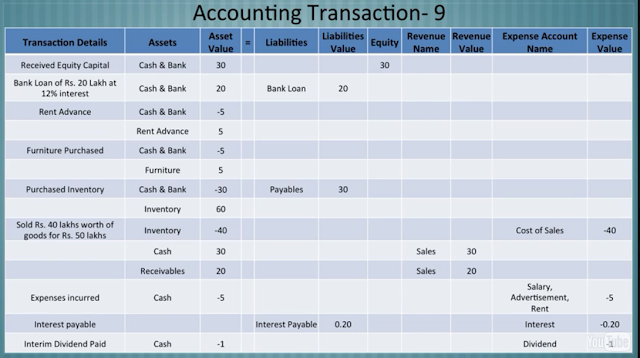
    This image has an empty alt attribute; its file name is Screenshot_10.png
    Transaction Image to learn Accounting Transaction in more detail: Image for educational purpose only just used for Balance Sheet preparation

    Pages: 1 2 3 4

  • SFAS 78 With Summary

    SFAS 78 With Summary

    SUMMARY OF STATEMENT NO. 78
    CLASSIFICATION OF OBLIGATIONS THAT ARE CALLABLE BY THE CREDITOR—AN AMENDMENT OF ARB NO. 43, CHAPTER 3A (ISSUED 12/83)Summary
    This Statement amends ARB No. 43, Chapter 3A, “Current Assets and Current Liabilities,” to specify the balance sheet classification of obligations that, by their terms, are or will be due on demand within one year (or operating cycle, if longer) from the balance sheet date. It also specifies the classification of long-term obligations that are or will be callable by the creditor either because the debtor’s violation of a provision of the debt agreement at the balance sheet date makes the obligation callable or because the violation, if not cured within a specified grace period, will make the obligation callable. Such callable obligations are to be classified as current liabilities unless one of the following conditions is met:
    The creditor has waived or subsequently lost the right to demand repayment for more than one year (or operating cycle, if longer) from the balance sheet date.
    For long-term obligations containing a grace period within which the debtor may cure the violation, it is probable that the violation will be cured within that period, thus preventing the obligation from becoming callable.
    Short-term obligations expected to be refinanced on a long-term basis, including those callable obligations discussed herein, continue to be classified in accordance with FASB Statement No. 6, Classification of Short-Term Obligations Expected to Be Refinanced. This Statement is effective for financial statements for fiscal years beginning after December 15, 1983 and for interim periods within those fiscal years.

    Source: FASB

    Thanks for reading.